


Why NBA Sports Bets Attract More Money Every Season
I placed my first NBA bet in 2020 — a $50 moneyline wager on a team I'd barely researched, based on a hunch that felt like conviction. I lost. Not dramatically, not on a buzzer-beater, but in the quiet, predictable way that bad process leads to bad outcomes. Six years of statistical modeling later, I can tell you the exact mistake I made that night: I confused having an opinion with having an edge. That distinction — between feeling right and being right — is the central tension of NBA sports betting, and it's what this guide is built around.
The NBA has become the second most popular league for sports wagering in the United States, drawing roughly 58% of American bettors and trailing only the NFL. The reasons are structural: an 82-game regular season generates hundreds of betting opportunities per week, player-level data is deeper and more accessible than in any other sport, and the rise of mobile betting has made it possible to act on a line before the public even notices it moved. The global sports betting market reached $112.26 billion in 2025, and basketball's slice of that total is growing faster than the industry average.
NBA betting market context: The NBA market is valued at $13.92 billion in 2026 and is projected to reach $20.04 billion by 2031, growing at a compound annual rate of 7.56%. In the U.S. alone, legal sportsbooks processed $166.94 billion in total handle during 2025 — an 11% increase year over year — and generated $16.96 billion in revenue.
That growth is not happening in a vacuum. The October 2025 gambling scandal — 34 arrests, active players and a head coach charged, organized crime involvement — exposed vulnerabilities that the industry had largely papered over. At the same time, regulators are debating the SAFE Bet Act, the NBA itself is pushing to limit certain prop bet categories, and problem gambling rates among sports bettors are running at least double the baseline population. The market is expanding and getting messier simultaneously.
This guide exists because most NBA betting content falls into one of two categories: shallow overviews that define a spread and stop there, or daily picks with no structural analysis behind them. I wanted to build something different — a resource grounded in peer-reviewed research, verifiable market data, and six years of tracking where the numbers actually lead. Whether you're evaluating your first NBA wager or refining a model that's already profitable, the framework here is the same: understand the market mechanics, identify where the data diverges from the line, and size your bets to survive the variance that basketball guarantees. The data is current through the 2025-26 season. The analysis is mine.
The Numbers That Shape Every NBA Wager in This Guide
- Home teams win 61.55% of NBA games, but that edge has compressed to the mid-50s in recent seasons — treat home court as a variable, not a constant, and price it at 2-3 points on the spread.
- Back-to-back teams fail to cover the spread 57% of the time, with away-away sequences dropping to a 39.2% win rate. Rest differentials are the most accessible analytical edge in NBA betting.
- Player props in niche categories — blocks (69.9% over rate), three-pointers (63.2%), steals (61.9%) — show persistent mispricing that team-level markets don't offer.
- Parlays generate 60% of sportsbook revenue from 30% of handle. The math punishes multi-leg bets; limit parlays to 2-3 correlated legs or treat them as entertainment.
- Professional NBA bettors target 53-55% win rates for 3-5% seasonal ROI. Bankroll management — 1-3% unit sizing with stop-loss protocols — determines survival more than pick quality.
Core NBA Bet Types Every Bettor Should Know
Three years into building my own NBA model, I realized that the bettors who consistently lost weren't failing at analysis — they were failing at market selection. They'd spend hours evaluating a matchup, then place the wrong type of bet for the situation. Every wager is a statement about the game, and the bet type determines how precisely that statement gets tested.
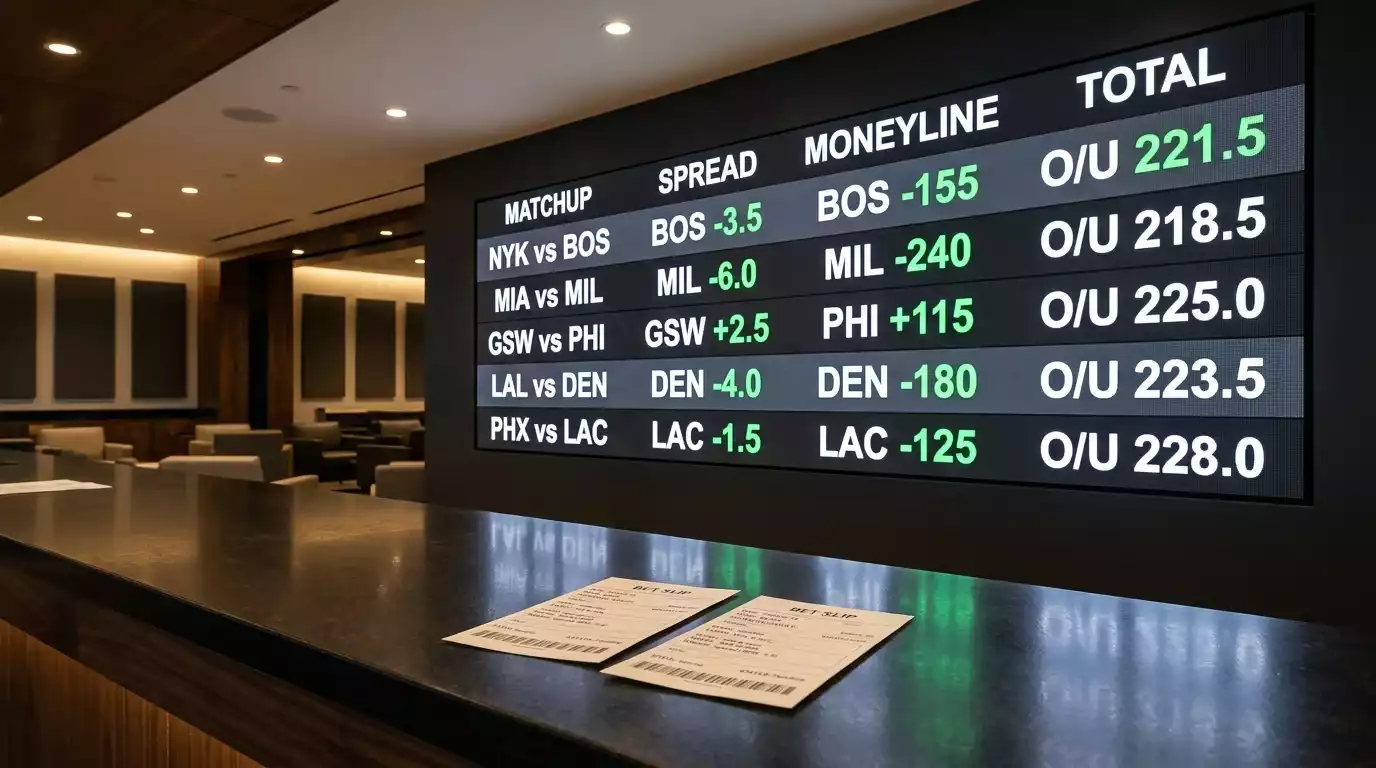
NBA sportsbooks offer three core categories that account for the vast majority of handle: point spreads, moneylines, and totals. Each asks a different question, carries different risk-reward characteristics, and responds to different analytical inputs. Home court advantage is baked into every line you'll encounter, but how deeply it's priced varies by market, team, and situation.
ATS (Against the Spread) — a measure of how often a team covers the point spread. A team that goes 45-37 ATS is covering the spread in 54.9% of games, which matters more for profitability than their straight-up win-loss record.
O/U (Over/Under) — the projected combined score of both teams. You bet on whether the actual total will finish above or below the sportsbook's number.
SU (Straight Up) — a team's win-loss record without considering the point spread. Relevant for moneyline bettors who only need their team to win, regardless of margin.
Point Spread: Handicapping the Favorite
The point spread is the sportsbook's answer to a simple problem: how do you make a lopsided game interesting to bet on both sides? A spread of -7.5 means the favorite must win by 8 or more points for a spread bet on them to cash. The underdog can lose by 7 and still cover. It's the great equalizer of NBA betting — the mechanism that turns a 15-win team vs. a 50-win team into a roughly 50/50 proposition.
Example spread line:
Team A -6.5 (-110) vs. Team B +6.5 (-110)
If you bet Team A, they need to win by 7 or more. Bet Team B, and they can lose by up to 6 and you still profit. The -110 on both sides represents the vig — the sportsbook's cut.
The average NBA home court advantage translates to roughly 2-3 points on the spread, though this varies significantly by team and venue. Denver's altitude factor, for instance, has historically pushed its home edge higher than the league average. What matters for spread bettors isn't whether a team wins, but whether the margin of victory exceeds the bookmaker's projection. I've found over six seasons of tracking that the most profitable spread situations cluster around specific game contexts — rest advantages, travel patterns, and injury-driven line movements — rather than around team quality alone. For a deeper dive into spread mechanics and when to exploit them, the complete guide to NBA point spread betting breaks down ATS records, closing line value, and the common mistakes that drain bankrolls.
Moneyline: Picking the Outright Winner
Moneyline bets strip the equation down to its purest form: pick the winner. No margin required. But that simplicity comes with pricing that punishes lazy thinking. A heavy favorite at -350 requires risking $350 to win $100, while the underdog at +280 returns $280 on a $100 stake. The implied probability embedded in those odds tells you what the market thinks — your job is to decide whether the market is wrong.
Example moneyline:
Team A -250 (implied probability: 71.4%) vs. Team B +200 (implied probability: 33.3%)
The gap between those implied probabilities exceeds 100% — the difference is the vigorish. True probabilities are lower on both sides.
Moneyline betting rewards selectivity. The margins between NBA teams are narrower than in football, meaning underdogs win more often and pay generously when they do. The challenge is identifying game states where a +180 underdog is actually a 40% proposition rather than the 35.7% the line implies. The moneyline betting guide covers implied probability math and the scenarios where picking straight-up winners beats the spread as a market choice.
Totals (Over/Under): Forecasting Combined Scores
The totals market asks you to ignore who wins and focus on how the game is played. A line of 224.5 means the sportsbook projects the two teams to combine for approximately that many points. You bet over or under. It sounds straightforward until you realize that pace — the number of possessions per game — varies dramatically across NBA teams, and a 10-possession pace difference can swing the expected total by 15 or more points.
Example total line:
Total: 221.5 — Over (-108) / Under (-112)
The slight price difference signals the book expects more action on the over and is shading the under accordingly. Totals are particularly sensitive to injury news that changes expected pace.
Totals betting is where advanced analytics shine brightest. Offensive and defensive efficiency ratings, pace-adjusted projections, and rest-day scoring differentials all feed directly into total predictions. A team averaging 114 points on normal rest might average 109-111 on the second night of a back-to-back — enough to push a game under a total the market set based on season averages.
Player Props and Stat-Based Wagers
The fastest-growing corner of NBA betting doesn't ask you to predict who wins or by how much. It asks whether a specific player will hit a specific statistical threshold — 24.5 points, 8.5 rebounds, 6.5 assists — and the precision of that question is exactly what makes it dangerous and profitable in equal measure. Player props are where the analytical bettor can find the most persistent edges, because individual matchup data, rotation patterns, and minute projections are harder for sportsbooks to price perfectly than team-level outcomes.
I started tracking prop market efficiency in the 2022-23 season, and what struck me immediately was how unevenly the accuracy was distributed across categories. Not all props are created equal. The market prices points and assists with reasonable efficiency — these are high-volume, high-visibility stats that attract sharp action quickly. But move into secondary categories like blocks, steals, and three-pointers made, and the pricing gets sloppier.
Blocks (over)
69.9% win rate across 10,580 graded predictions in 2025-26
Three-pointers (over)
63.2% win rate — driven by pace inflation and increased volume league-wide
Steals (over)
61.9% win rate — the most volatile category, but consistently underpriced
Those numbers come from AI-graded prediction engines processing thousands of outcomes, and they point to a structural tendency among sportsbooks: they set niche prop lines conservatively because the betting volume is lower and the cost of being wrong is smaller per-market. For the bettor who's willing to do the matchup work — checking defensive block rates, pace projections, and minutes expectations — niche props offer a genuine edge that team-level markets rarely provide.
When a team's leading scorer is ruled out, the props on the second and third scoring options often lag behind the actual production bump by 30 to 90 minutes. That repricing window — the gap between injury confirmation and full line adjustment — is where some of the most reliable value in NBA betting lives. A key absence can shift expected output for secondary scorers by 4 to 8 points, but the market initially adjusts by only a fraction of that.
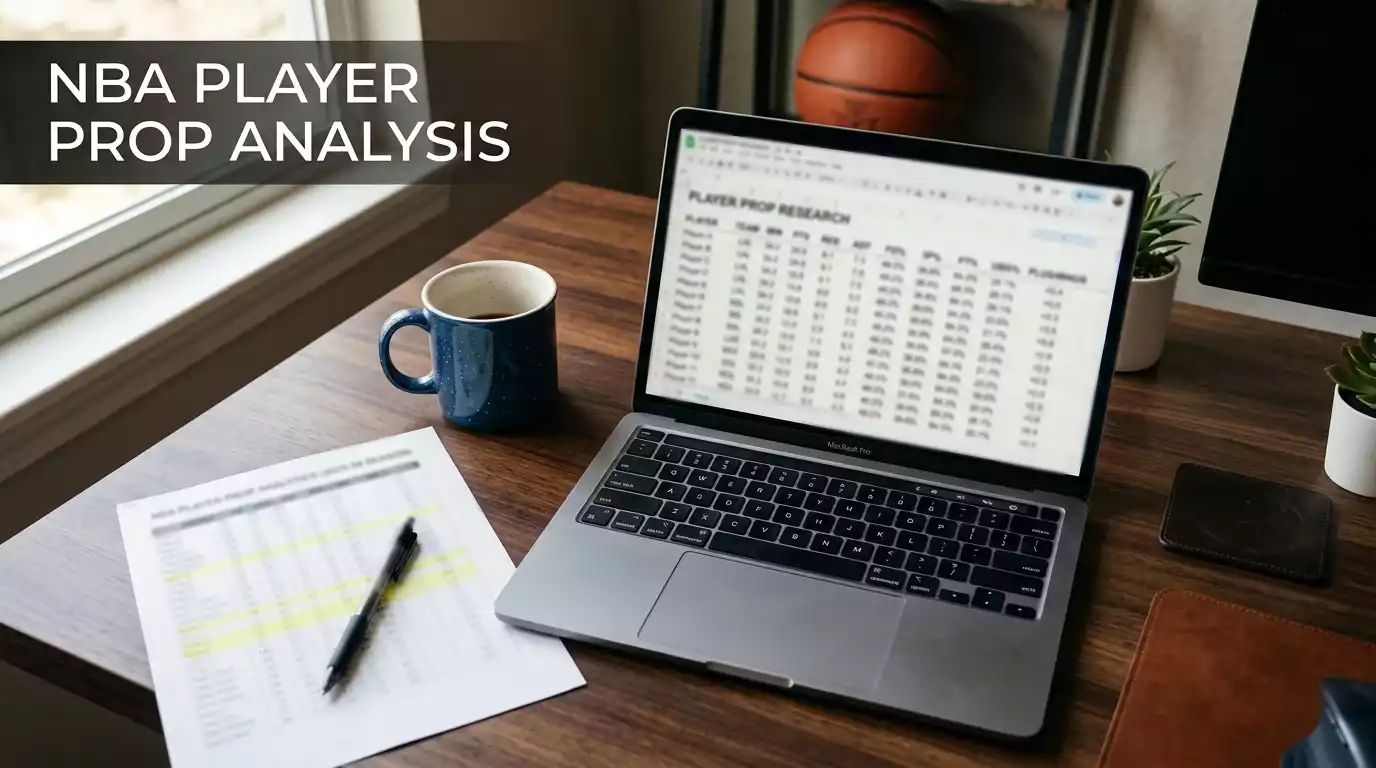
The flip side of player props is integrity risk. The October 2025 scandal exposed exactly how vulnerable individual performance markets are to manipulation — it's far easier to influence a single player's stat line than a game outcome. The NBA has since pushed to limit certain prop categories and tighten injury reporting timelines. For bettors, this means the prop landscape is evolving: some markets may shrink or disappear, while others will persist with wider lines that reflect the sportsbook's increased caution. The player prop betting strategy guide covers win rates by category, injury cascade effects, and how to identify mispriced lines before the market catches up.
Parlays and Same-Game Parlays in the NBA
Nothing in sports betting feels quite as electric as a four-leg parlay hitting on a Sunday slate. I've hit them. I've also tracked my parlay results over four full seasons, and the data tells a story the dopamine doesn't: parlays are the single most profitable product for sportsbooks and the single most expensive habit for bettors. The share of bettors placing parlays doubled from 17% in 2018 to 30% in 2024, and the industry loves every percentage point of that growth — because parlays account for roughly 30% of handle but generate approximately 60% of gross revenue.
The math is straightforward once you see it. Every leg you add to a parlay multiplies not just the potential payout but the sportsbook's built-in vig. A two-leg parlay at standard -110 juice carries an effective vig of around 10%. A four-legger pushes that toward 20%. By six legs, you're paying a house edge that would make a roulette wheel blush.
Parlay payout calculation — three legs at -110 each:
Each -110 leg implies a 52.38% probability. True fair odds for all three hitting: 0.5238 x 0.5238 x 0.5238 = 14.37%.
A fair payout for a 14.37% event is +596. Typical sportsbook payout for a three-leg parlay at -110: approximately +600.
Looks close, right? But the 52.38% per leg already includes the vig. If the true probability per leg is 50%, the fair three-leg payout is +700. The sportsbook is paying you +600 for a +700 bet. That gap widens with every additional leg.
Same-game parlays — SGPs — have exploded in popularity because they let bettors combine outcomes from a single contest: a team to win, the total to go over, and a player to hit his points prop. The appeal is narrative coherence — if the game goes the way I think it will, all three legs cash. The risk is that sportsbooks price SGPs using proprietary correlation models, and you have no way to verify whether their correlation adjustment is fair. In many cases, the correlated legs you're combining would individually be positive-expected-value bets, but the SGP pricing removes that edge entirely.
Do
- Limit parlays to 2-3 legs with correlated outcomes — for example, a team covering the spread combined with the game going over, where the team's expected blowout implies high scoring
- Calculate the implied probability of each leg independently before combining them
- Treat parlay stakes as entertainment budget, not core wagering activity
Don't
- Build 5+ leg parlays expecting to profit long-term — the compounding vig makes sustained profitability nearly impossible
- Assume SGP correlation is priced fairly — the sportsbook controls that adjustment and it always favors the house
- Chase losses with increasingly complex parlays — this is the fastest path to bankroll destruction in NBA betting
There's a place for parlays in a disciplined NBA betting portfolio, but it's a small one. The comprehensive parlay guide breaks down the math in detail, including when correlated parlays actually offer positive expected value and how to evaluate whether a sportsbook's parlay boost is genuine or marketing theater.
Live NBA Betting: In-Play Markets and Timing
The line moved three points in 47 seconds. I was watching a mid-January game last season — nothing marquee, just two middle-of-the-pack teams — when the starting center picked up his third foul early in the second quarter. The live spread adjusted almost instantly, but the total lagged behind by nearly a full minute. That 60-second gap between the spread repricing and the total repricing was enough to place a bet at a number that no longer reflected the game state. More than half of all NBA wagers now happen after tip-off, and moments like that explain why.
Live betting — also called in-play or in-game wagering — flips the traditional model. Instead of analyzing pregame data and locking in a position, you're reacting to what's actually happening on the court. The markets available are extensive: live spreads, live totals, quarter lines, next-team-to-score props, and increasingly granular player performance markets that update possession by possession. Ninety percent of sports bets are placed through mobile apps, and the live betting interface is where that mobile-first reality matters most — latency, refresh speed, and ease of execution separate functional platforms from frustrating ones.
Quarter dynamics and live value: Research analyzing 2,295 NBA games over a decade found that 19% of contests remain within 10 points entering the fourth quarter. Physical performance between the first and fourth quarters declines measurably, with an effect size of -1.27 documented in a peer-reviewed study by Garcia et al. That decline accelerates on back-to-back nights and during the third game in a four-day stretch. Fourth-quarter pace typically drops to 90-100 possessions, tightening scoring windows and increasing the relative value of free throw efficiency over raw shooting.

The edges in live NBA betting are different from pregame. They're faster, smaller, and more dependent on reading game flow than on modeling team strength. A team trailing by 12 at halftime after shooting 25% from three isn't going to keep shooting 25% from three — regression is coming, and the live spread at -14.5 might already be overcompensating for the first-half performance. Conversely, a team leading by 8 in a game where its best player has four fouls is more fragile than the live number suggests. These are the situational reads that make live betting profitable for bettors who watch games actively and unprofitable for bettors who chase lines they saw on a notification.
I treat live betting as a separate discipline from pregame wagering. The skill set is different — it rewards pattern recognition and emotional discipline over statistical modeling. The live betting strategy guide covers timing frameworks for in-play spreads and totals, quarter-by-quarter dynamics research, and the specific traps that turn live betting from an edge into a leak.
Live markets react to what's happening now — but the most patient NBA bets lock in value months before the first game is played.
NBA Futures: Championship, MVP, and Season-Long Wagers
Every October, I run the same exercise: I pull up championship futures across three sportsbooks, compare the implied probabilities to my preseason model projections, and look for the widest gaps. Some years I find two or three bets worth making. Other years I find none. Futures betting rewards patience and punishes the urge to have action — and that restraint is exactly why most bettors avoid it. There's no instant gratification in a ticket that won't settle for eight months.
NBA futures markets cover championship odds, conference winners, division winners, regular-season win totals, and individual awards like MVP, Rookie of the Year, and Defensive Player of the Year. A meaningful slice of the NBA's multi-billion-dollar betting market flows through futures handles placed before the season even starts. The appeal is structural: because futures prices reflect the market's consensus months before outcomes are known, early positions capture value that disappears as information accumulates.
| Factor | Pre-season futures | Mid-season futures |
|---|---|---|
| Information available | Roster projections, offseason moves, coaching changes | 30-40 games of actual performance data, injury history |
| Typical odds range (contender) | +400 to +800 | +150 to +400 |
| Market efficiency | Lower — public overweights narratives, underweights depth | Higher — results narrow the field, sharps are positioned |
| Key advantage | Best price on correct projection; hedge opportunities later | More data to validate thesis; fewer losing positions |
| Primary risk | Injury to franchise player erases value with no exit | Better prices already gone; shorter time for value to compound |
The strategic question isn't whether pre-season or mid-season futures are "better" — it's which approach matches your analytical process. If your edge comes from roster evaluation and system projection, pre-season is your window. If you need to see 30 games of data before committing capital, mid-season entries at compressed odds still beat laying -180 on a conference finals spread in May.
One dynamic I've come to respect is the hedging option that early futures provide. A $200 pre-season championship bet at +800 on a team that reaches the conference finals can be partially hedged against its opponent, guaranteeing profit regardless of outcome. That optionality has real value — and it's only available to bettors willing to commit capital months before the market converges on a consensus.
Data-Driven NBA Betting Strategy
Whether you're betting futures eight months out or spreads two hours before tip-off, the underlying process is the same — and the single most expensive belief in NBA betting is that watching games makes you good at it. I watched roughly 400 games in my first season of serious wagering and finished down 8%. The next season, I watched fewer games but built a spreadsheet tracking rest days, pace differentials, and ATS records by game context. I finished up 4.2%. Watching basketball makes you a better fan. Tracking the right data makes you a better bettor. The two skills overlap less than you'd think.
CourtEdge · Rest & Schedule
The Rest-Edge Calculator
Rest differential is the most accessible edge in NBA betting. Back-to-back teams cover only ~43% ATS, and away-away B2Bs win just 39.2%. Set each team's schedule spot and see the ATS edge, the spread points to shave, and how far the total should drop.
Team A · your side
Days of rest
Back-to-back type
Team B · opponent
Days of rest
Back-to-back type
Roster age profile
Home team & conference
ATS edge · fresher side
57%
Cover rate from rest alone
Spread points to shave
2.3
Off the tired team's line
Total knock-down
4.1
Points off the O/U line
NBA Commissioner Adam Silver acknowledged the structural shift when he said that with regulated, legalized betting, the league can monitor activity in ways that were previously unimaginable — from geotargeting bet origins to flagging aberrational wagering patterns. That monitoring infrastructure exists because the NBA recognizes what sharp bettors have known for years: the data trail is the signal. Game outcomes are noisy. Contextual data is not.
Pre-bet analysis framework
- Check rest differential: How many days since each team's last game? Is either team on the second night of a back-to-back?
- Review injury reports: Has the line fully adjusted to confirmed absences, or are sportsbooks still catching up to the news?
- Compare pace metrics: What's the expected possession count for this matchup, and how does it align with the total?
- Evaluate home/away context: Is the home team in a favorable rest position? Does the venue carry an above-average home edge?
- Monitor line movement: Has the spread moved toward or against your position since opening? Reverse line movement — where the line moves opposite to public betting percentages — signals sharp action.
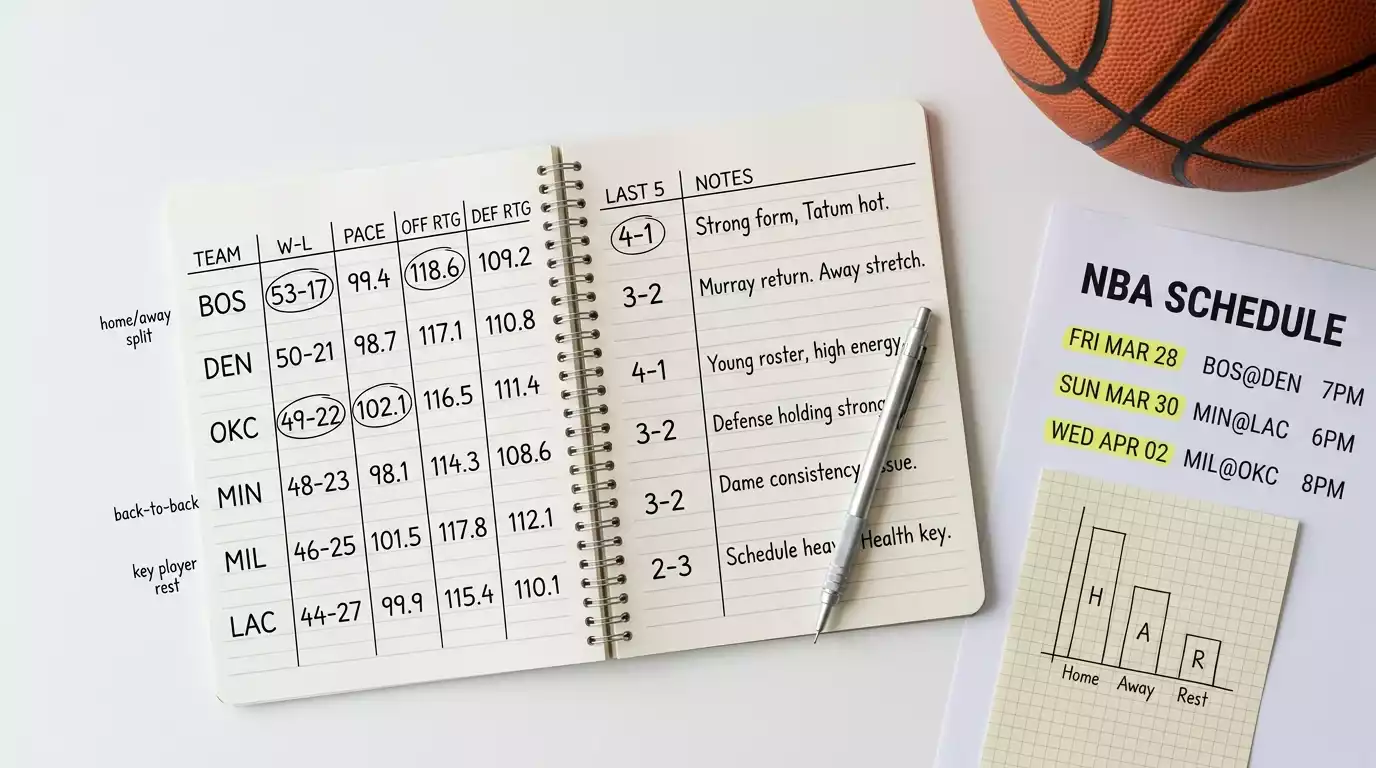
Professional bettors target a win rate between 53% and 55% on spread bets, which translates to roughly 3-5% ROI over an NBA season at standard -110 juice. That margin sounds thin because it is thin — and the entire strategic apparatus exists to capture and protect it. The edges come not from predicting winners, but from identifying specific game contexts where the market systematically misprices outcomes.
Home court: 61.55%
NBA home win percentage across 24 seasons of data. Worth 2-3 points on the spread.
Back-to-back ATS: 43%
Teams cover the spread only 43% of the time on zero days' rest — a 57% fade rate.
Pro win rate target: 53-55%
The threshold for sustained profitability at standard vig. Even 1% above 52.4% break-even compounds across 1,000+ bets per season.
Home Court Advantage by the Numbers
Home teams in the NBA win 61.55% of their games — a figure drawn from a peer-reviewed analysis spanning 24 regular seasons. But that league-wide average masks a significant conference split: Western Conference home teams post a 64.5% win rate versus 58.5% in the East. The gap likely reflects the greater travel distances in the West, where a road trip from Portland to Miami covers three time zones and 4,700 kilometers.
For spread bettors, home court translates to approximately 2-3 points on the line. That number is the market's baseline, and most sportsbooks price it reasonably well. The edge doesn't come from betting every home team — it comes from identifying where the actual home advantage deviates from the market's assumed 2-3 points. Denver's altitude effect has historically pushed its home edge above the league average, while certain arenas in less engaged markets show a smaller-than-expected lift. The conference split between East and West, the post-COVID compression of home win rates into the mid-50s, and venue-specific altitude effects all create pockets where the market's generic 2-3 point adjustment doesn't match reality.
Back-to-Back Fatigue and Rest-Day Edge
Teams on the second night of a back-to-back lose against the spread approximately 57% of the time. That's the headline number, and it's robust across multiple seasons of data. But the mechanism underneath it is more nuanced than simple tiredness. Research published in the Journal of Clinical Sleep Medicine found that away-away back-to-back sequences — where a team plays consecutive road games — produce a winning percentage of just 39.2%, while away-home sequences recover to 54.4%. The type of back-to-back matters as much as the existence of one.
Garcia et al. documented a measurable physical performance decline from first to fourth quarter with an effect size of -1.27. That decline steepens on zero days' rest, particularly for players over 30, whose recovery rates slow measurably. Scoring output on back-to-backs drops 3-5% on average — enough to push a game under a total set to the team's season average and enough to cost a favorite the cover against a spread that hasn't fully adjusted for the schedule spot. I flag every back-to-back in my weekly model and treat the rest differential between opponents as a primary input, not a tiebreaker.
Bankroll Management for NBA Bettors
I know bettors with sharp analytical minds who have gone broke. Not because their picks were bad — their season-end ATS records would have been profitable with proper staking — but because a three-week cold streak wiped out a bankroll that was too concentrated to survive normal variance. NBA betting is a long-frequency game: 1,230 regular-season games, 15-20 bets per week for an active bettor, and the statistical certainty that even a 56% win rate will produce losing stretches of 10 or more consecutive bets. Bankroll management determines whether you're still in action by April.
The foundation is unit-based sizing. One unit equals a fixed percentage of your total bankroll — typically 1-3% for standard plays and up to 5% for situations where your model shows a significant edge. The discipline is in never exceeding the system, especially when conviction is highest, because that's precisely when emotional bias is most likely to distort your assessment of edge size.
Unit sizing example:
Starting bankroll: $5,000. Unit size: 2% = $100 per standard bet.
At a 54% win rate on -110 lines over 500 bets: expected profit = 500 x (0.54 x 0.909 - 0.46 x 1.0) = 500 x (0.491 - 0.460) = 500 x 0.031 = $15.50 per bet average, or approximately $7,750 in expected profit.
Maximum drawdown at this win rate (calculated at 95% confidence): approximately 25-30 units, or $2,500-$3,000. A bankroll of 50-100 units provides enough cushion to survive the worst expected losing streaks without busting.
Professional bettors targeting 53-55% win rates across a season expect 3-5% ROI on total volume. That sounds modest — and it is. The compounding comes from disciplined repetition over hundreds of wagers, not from any single brilliant pick. Most recreational bettors lose not because they can't find winners, but because they oversize their bets during winning streaks and chase losses during cold spells.
Do
- Set a fixed unit size before the season and recalculate monthly based on current bankroll
- Track every bet in a spreadsheet: date, market, odds, stake, result, and running P&L
- Build a stop-loss protocol — if your bankroll drops 20%, reduce unit size rather than increasing it
Don't
- Increase bet size after a win streak to "press" your advantage — variance doesn't know your recent record
- Bet more than 5% of your bankroll on any single wager, regardless of perceived edge
- Use money earmarked for essentials — rent, food, bills — as betting capital under any circumstance
The NBA Betting Market in 2026
When the Supreme Court struck down the Professional and Amateur Sports Protection Act in May 2018, Nevada was the only state where you could legally bet on an NBA game. Eight years later, sports betting is legal in 38 states plus the District of Columbia, and the industry has processed more than $600 billion in cumulative handle. The speed of that expansion — from a single-state curiosity to a nationwide infrastructure generating nearly $17 billion in annual revenue — has outpaced almost every projection made at the time of legalization. Bill Miller, president of the American Gaming Association, noted in February 2026 that legal commercial gaming delivered exceptional results for consumers, operators, and the communities the industry serves. The numbers justify that assessment, even as the complications multiply.

$166.94 billion
Total U.S. sports betting handle in 2025, up 11% year over year
$16.96 billion
U.S. sports betting revenue in 2025, up 22.8%
$3.71 billion
State tax revenue from regulated sportsbooks in 2025, up 32.4%
The NBA's position within this landscape is distinctive. Basketball draws approximately 58% of American bettors — second only to the NFL — but its structure generates more individual betting events per season than any other major league. An 82-game regular season across 30 teams, a months-long playoff run, and the deepest player-level statistical ecosystem in professional sports make the NBA uniquely suited to the granular betting markets that drive handle growth: props, SGPs, live wagers, and quarter lines.
Tax landscape: State tax rates on sportsbook revenue vary dramatically. Illinois introduced a progressive rate reaching 40% in July 2025, plus a per-bet fee of $0.25-$0.50, which contributed to a 15% decline in betting volume that fall. Nevada maintains a flat rate well below that threshold. The divergence in tax policy is creating an uneven competitive landscape where operators shift promotional spending based on state-level economics, and bettors in high-tax states may face wider spreads as operators protect margins.
Two forces are complicating the growth story. Prediction markets — platforms allowing wagering on event outcomes outside the traditional sportsbook model — diverted an estimated $500 million in potential sports betting tax revenue in 2025, according to AGA data. These markets operate under different regulatory frameworks and are drawing handle away from licensed sportsbooks. Meanwhile, the regulatory environment is fragmenting. The SAFE Bet Act, introduced in Congress to establish federal standards, has gained bipartisan attention but remains stalled. Each state sets its own rules on tax rates, permitted bet types, and advertising restrictions — a patchwork that creates inconsistent experiences for bettors crossing state lines.
For the individual bettor, the practical takeaway is that the market you bet in affects the value you receive. Line quality, prop availability, and promotional offers vary by operator and by state. Serious NBA bettors maintain accounts at multiple sportsbooks and shop lines for every bet — a practice that captures 1-2% of additional edge over a season.
Integrity, Scandals, and What They Mean for Bettors
On October 23, 2025, 34 people were arrested in connection with two federal investigations into illegal sports betting and Mafia-backed poker games involving NBA personnel. Among them: Miami Heat guard Terry Rozier, Portland Trail Blazers head coach Chauncey Billups, and former player Damon Jones. FBI Director Kash Patel called it the insider trading saga for the NBA, and that framing was apt — the alleged schemes didn't involve fixing game outcomes but rather exploiting non-public information about player availability to gain an edge in prop betting markets.
The 2025 scandal in context: Rozier was accused of withdrawing from a March 2023 game after telling an associate he'd exit early, enabling pre-arranged prop bets on his statistical underperformance. Jones allegedly sold injury information about Lakers players — including details about LeBron James and Anthony Davis — to bettors before the information became public. Billups was charged in a separate scheme involving rigged high-stakes poker games organized by La Cosa Nostra crime families, where rigged shuffling machines and pre-marked cards were used to defraud other players.
The scandal didn't arrive in isolation. In 2024, Jontay Porter received a lifetime ban from the NBA for providing insider information and deliberately altering his own performance to influence prop bets. The pattern is consistent: individual performance markets are the vulnerability. It's far easier for one person to influence a single stat line — minutes played, points scored, rebounds grabbed — than to fix the outcome of a team sport played by 10 athletes. NBA Commissioner Adam Silver acknowledged this directly, stating that there's nothing more important than the integrity of the competition and that prop bets on individual player performance involve heightened integrity concerns requiring additional scrutiny.
Regulatory response: In the wake of the arrests, the NBA sent a memo to all 30 teams proposing changes to injury reporting timelines, limitations on certain prop bet categories, and enhanced integrity monitoring. The Senate Commerce Committee requested a formal briefing from Commissioner Silver. Several operators voluntarily pulled specific prop markets from their platforms while the investigation continued. The league's partnership with monitoring services that track aberrational betting patterns in real time — flagging unusual volume on player unders, for example — detected the Rozier situation as it happened, though the internal investigation initially cleared him.
For bettors, the implications are practical. Prop markets on individual players are likely to face tighter limits and reduced availability in coming seasons. The edge currently available in niche prop categories may shrink as sportsbooks increase caution. And the same 30-90 minute repricing window that creates value for diligent bettors also creates opportunity for those with non-public information — unusual line movement around an injury report is always a signal worth monitoring.
Responsible Gambling: Protecting Your Edge and Yourself
I debated whether to include this section or bury it in a footer link. I chose to put it here — between the market analysis and the FAQ — because it belongs in the conversation, not outside it. The same analytical mindset that makes someone a good NBA bettor can also blind them to the point where process becomes compulsion. Problem gambling rates among sports bettors run at least double the rate found in the general gambling population, and the infrastructure that makes NBA betting accessible — 24/7 mobile apps, instant deposits, push-notification odds alerts — also makes it harder to stop when stopping is the right decision.
Cait Huble, Director of Public Affairs at the National Council on Problem Gambling, described the post-legalization landscape as the largest and fastest explosion of gambling the country has ever seen, adding that we're a decade behind other addictions in terms of public understanding. The data supports that characterization. Approximately 2.5 million American adults experience severe gambling problems, while 5 to 8 million exhibit some level of problematic behavior. Among young men aged 18 to 34 — the demographic most heavily represented in NBA betting — 13.4% meet clinical criteria for gambling disorder, the highest rate of any demographic group.
Public sentiment is shifting: A 2025 Pew Research study found that 43% of American adults believe legal sports betting is harmful to society, up from 34% in 2022. That nine-point increase in just three years reflects growing awareness of the social costs that accompany the industry's revenue growth. At the same time, only 39% of Americans consider gambling addiction a "very serious" problem, compared to 62% for substance abuse and 55% for alcohol dependency — a perception gap that delays both policy responses and individual help-seeking.
The behavioral warning signs are well-documented but easy to rationalize when you're the one exhibiting them: betting more than you planned, chasing losses with larger wagers, hiding betting activity from people close to you, borrowing money to fund bets, and feeling restless or irritable when trying to cut back. The average debt accumulated by a problem sports bettor before seeking help is approximately $27,500 — a number that can accumulate quickly when mobile apps allow instant deposits at any hour.
If your betting has moved from calculated to compulsive, help is available. The National Problem Gambling Helpline operates 24/7 at 1-800-522-4700. Most regulated sportsbooks also offer self-exclusion tools, deposit limits, and activity-time reminders that can be activated from within the app. Using these tools is not a sign of weakness — it's the same kind of discipline that defines successful bankroll management.
Every sportsbook operating legally in the United States is required to provide responsible gambling resources — self-exclusion programs, deposit limits, cooling-off periods, and reality checks. My recommendation is to set deposit limits and loss limits at account creation, before you've placed a single bet, because the moment you need those guardrails is the moment you're least likely to install them voluntarily.
Frequently Asked Questions About NBA Sports Bets
What types of bets can you place on NBA games?
The core markets are point spreads (predicting the margin of victory), moneylines (picking the outright winner), and totals (whether the combined score goes over or under a posted number). Beyond those, player props target individual stat lines — points, rebounds, assists, blocks, steals, three-pointers. Parlays combine multiple selections into a single higher-risk, higher-reward ticket. Futures cover season-long outcomes like the championship or MVP. Live betting opens all of these markets after tip-off with real-time odds updates.
How does the NBA point spread work?
The spread is a margin assigned by the sportsbook to equalize action on both sides. A team listed at -6.5 must win by 7 or more for a spread bet on them to cash; the opponent at +6.5 covers by winning outright or losing by 6 or fewer. The number reflects talent differentials adjusted for home court, rest, and injuries. Most spread bets are priced at -110 per side, meaning you risk $110 to win $100. The implied 52.38% break-even rate is the threshold every spread bettor needs to clear for long-term profit.
What is the best strategy for NBA betting?
Situational analysis beats team-level prediction. Track rest differentials and back-to-back schedules, monitor the 30-90 minute repricing window after injury confirmations, compare pace metrics to posted totals, and shop lines across multiple sportsbooks. Professional bettors target 53-55% on spreads for 3-5% seasonal ROI. Unit-based bankroll management — sizing bets at 1-3% of total capital — keeps you solvent through inevitable losing streaks. The edge comes from identifying recurring game contexts where the market misprices outcomes, not from picking winners on intuition.
Are player prop bets profitable in the NBA?
Certain prop categories show persistent profitability, particularly in secondary statistical markets. Data from the 2025-26 season across more than 10,000 graded predictions shows over-bets on blocks hitting at 69.9%, three-pointers at 63.2%, and steals at 61.9%. The primary scoring props — points, assists — are priced more efficiently and offer thinner margins. The key to prop profitability is matchup specificity: analyzing defensive tendencies, pace projections, and expected minutes rather than relying on season averages. Injury cascades also create value — when a star sits, secondary scorer props often lag behind the actual production bump for 30 to 90 minutes.
How do back-to-back games affect NBA betting lines?
Teams on the second night of a back-to-back fail to cover the spread about 57% of the time. Scoring drops 3-5% compared to normal rest, with three-point shooting declining by roughly 1.0-1.5 percentage points. The impact varies by sequence: away-away back-to-backs produce a winning percentage of just 39.2%, while away-home sequences recover to 54.4%. Coast-to-coast travel compounds the effect, pushing performance declines to 5-7%. Sportsbooks partially adjust their lines for fatigue, but the correction often underestimates the real impact, particularly for rosters leaning on older veterans.
What is home court advantage worth in NBA betting?
Across 24 seasons of NBA data, home teams win 61.55% of their games, and the spread market prices home court advantage at approximately 2-3 points. The advantage varies by conference — Western Conference home teams win at a 64.5% rate versus 58.5% in the East — and by specific venue. Denver's altitude has historically inflated its home edge above the league average. In recent seasons, however, the league-wide home winning percentage has compressed, dropping into the mid-50s in four of the last five seasons. The three-point revolution and improved road preparation have narrowed the gap, meaning bettors should treat home court as a variable rather than a constant.
How do injuries affect NBA odds and spreads?
A star's absence can move a spread by 4-8 points. The adjustment unfolds in stages: an initial shift when the injury report drops, then a sharper correction when the absence is confirmed near tip-off. The 30-90 minute window between confirmation and full line adjustment is where value concentrates — both in spreads and in props for teammates whose roles expand. Sportsbooks have improved repricing speed since the 2025 scandal, but adjustments remain imperfect for secondary scorer props and totals. Unusual line movement around injury news can signal both legitimate market correction and, in rare cases, information asymmetry worth monitoring.
