
 Available in US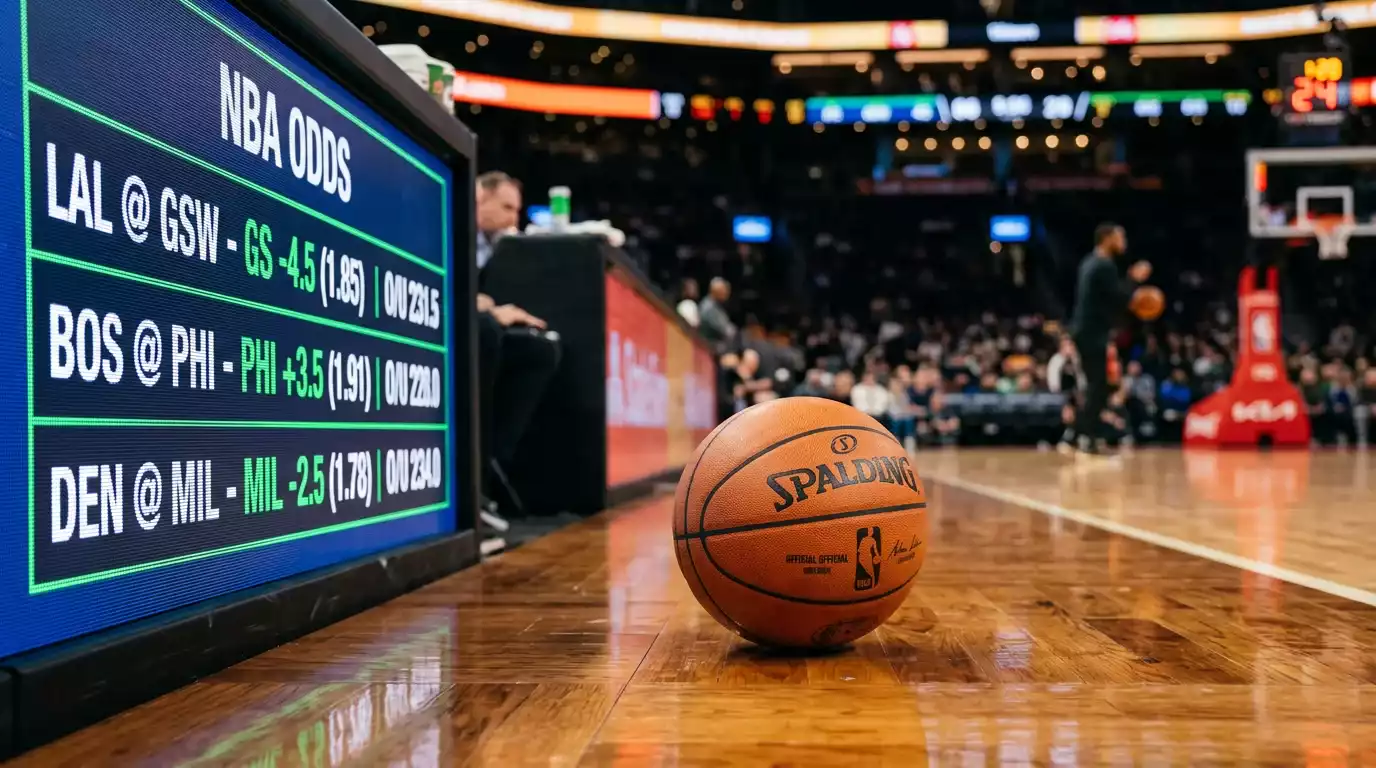
I still remember the first NBA bet I placed. Celtics moneyline at -180. I knew I was betting on Boston to win, but when someone asked me what -180 actually meant in dollar terms, I stammered through an answer that was technically wrong. I was risking real money on a number I didn’t fully understand. If that sounds familiar, this is the piece I wish I’d read before opening a sportsbook account.
NBA odds are the language of the betting market. They encode probability, risk, and the sportsbook’s margin into a single number. The total handle for legal US sports betting hit $166.94 billion in 2025, and every dollar of that volume passed through an odds format that most bettors read instinctively but few actually deconstruct. Once you understand what the number means — not just which side it points to, but the probability and value embedded in it — you stop gambling and start making informed decisions.
Three formats dominate the global market: American odds (the US standard), decimal odds (popular in Europe and Australia), and fractional odds (traditional in the UK). They all express the same underlying information, just in different mathematical languages. Mastering the conversions between them isn’t academic exercise — it’s a practical skill that lets you compare lines across international sportsbooks and spot pricing inefficiencies that bettors locked into one format would miss.
American, Decimal, and Fractional: Three Ways to Express the Same Edge
American odds use a baseline of $100 and split into positive and negative numbers. A negative number like -150 tells you how much you need to risk to win $100. A positive number like +130 tells you how much you’d win on a $100 stake. Simple enough on the surface, but the asymmetry trips people up. At -150, you’re laying $150 to win $100 (total return $250). At +130, you’re risking $100 to win $130 (total return $230). The favorite always has a higher absolute number because the sportsbook needs more from you to offset the higher probability of that outcome.
Decimal odds are cleaner mathematically. The number represents your total return per dollar wagered, including your original stake. So -150 American converts to 1.67 decimal: bet $100, get back $167 total ($100 stake + $67 profit). And +130 American converts to 2.30 decimal: bet $100, get back $230 total. The conversion formula from American to decimal is straightforward. For negative American odds, divide 100 by the absolute value of the odds and add 1. For positive odds, divide the odds by 100 and add 1.
Fractional odds — 3/1, 7/4, 11/10 — express profit relative to stake. A 3/1 bet returns $3 profit for every $1 wagered. They’re the oldest format and still common in UK horse racing, but rare in NBA markets. I mention them because you’ll encounter them on international exchanges, and converting to decimal is trivial: divide the fraction and add 1. So 3/1 becomes 4.0 decimal, and 7/4 becomes 2.75.
The practical value of knowing all three formats shows up when you’re line shopping across sportsbooks. An NBA spread at -110 American (1.91 decimal) at one book versus -105 (1.95 decimal) at another looks like a tiny difference. Over 500 bets in a season, that nickel in juice compounds into thousands of dollars. You can’t see that compounding effect unless you’re comfortable converting between formats quickly.
Implied Probability and the Built-In Vig
Here’s where odds stop being just a payout calculator and become an analytical tool. Every set of odds encodes an implied probability — the market’s estimate of how likely that outcome is. At -150 American, the implied probability is 60%. At +130, it’s 43.5%. Add them together and you get 103.5%, not 100%. That extra 3.5% is the vigorish (vig) — the sportsbook’s built-in margin that guarantees profit regardless of the outcome.
The November 2025 hold rate across US sportsbooks averaged 11.4%, meaning operators kept $11.40 of every $100 wagered. That’s the aggregate margin across all bet types, including parlays (which carry higher vig) and moneylines (lower vig). For standard NBA spreads at -110 both sides, the implied vig is about 4.5%. For moneylines on lopsided matchups, it can exceed 6-7%.
Removing the vig reveals the “true” implied probability the market assigns to each outcome. The formula is simple: take each side’s implied probability and divide by the sum of both sides’ implied probabilities. In our -150/+130 example, the true probabilities are 58% and 42%. If your own model says the favorite wins 63% of the time, you have a 5-percentage-point edge on that side. If your model says 55%, the underdog is the value play despite being the less likely winner.
I run this calculation on every bet I consider. Not because I think my model is perfect, but because it forces me to quantify my opinion in probability terms rather than relying on hunches. “I think the Bucks win tonight” is a feeling. “I assign Milwaukee a 64% win probability against a market-implied 58%” is a bet with defined expected value. The distinction matters more than any other skill in sports betting.
Why NBA Odds Move: Sharp Money, News, and Public Action
Adam Silver has pointed out that legalized, regulated betting allows monitoring capabilities that were unimaginable years ago — including the ability to detect aberrational betting patterns and pinpoint exactly where bets are being placed through geotargeting. That monitoring infrastructure exists because odds move in response to real money, and those movements tell a story.
Three forces drive NBA line movement, and they leave distinct footprints. Sharp money moves lines early and decisively. When respected bettors — accounts flagged by sportsbooks for consistent profitability — fire on one side, the book adjusts immediately even if the dollar amount is modest. A $5,000 bet from a sharp account moves the line more than $50,000 from a recreational account. If you see an NBA spread tick from -4 to -4.5 within 30 minutes of opening, that’s almost certainly sharp action.
Public money moves lines later, usually in the hours before tip-off. The public tends to bet favorites, overs, and primetime teams. When 75% of tickets are on one side but the line moves the other direction, that’s reverse line movement — a strong indicator that sharp money is opposing the public. These situations don’t guarantee a winner, but they identify games where the informed money disagrees with the crowd.
News — primarily injuries and lineup changes — creates the sharpest and most predictable line movements. A confirmed absence of a star player can swing a spread by 4-8 points and a total by 3-5 points. The speed of adjustment varies by sportsbook, and the 30-90 minute repricing window after an injury announcement is the most exploitable moment in the NBA betting calendar. If you have push notifications set for injury reports, you can occasionally grab a number that’s about to move significantly.
Understanding why odds move transforms your relationship with the betting market. You stop seeing -4.5 as a static number and start seeing it as the output of a dynamic process driven by money, information, and psychology. That shift in perspective is worth more than any single betting tip.
Reading Odds as a Skill, Not a Shortcut
Odds literacy won’t make you profitable by itself. Plenty of people understand -110 perfectly and still lose money because they bet too often, chase losses, or ignore bankroll management. But odds literacy is the prerequisite for everything else. You can’t evaluate expected value without calculating implied probability. You can’t line shop without converting between formats. You can’t assess whether a line movement is meaningful without understanding the forces behind it.
I treat odds reading the way a poker player treats hand rankings — it’s not a strategy, it’s the foundation on which every strategy is built. Spend time with the conversions until they’re automatic. Practice calculating implied probability on every line you see, even games you’re not betting. Within a few weeks, you’ll read an NBA betting board the way a musician reads sheet music: not one note at a time, but as a complete picture of what the market believes will happen.
