
 Available in US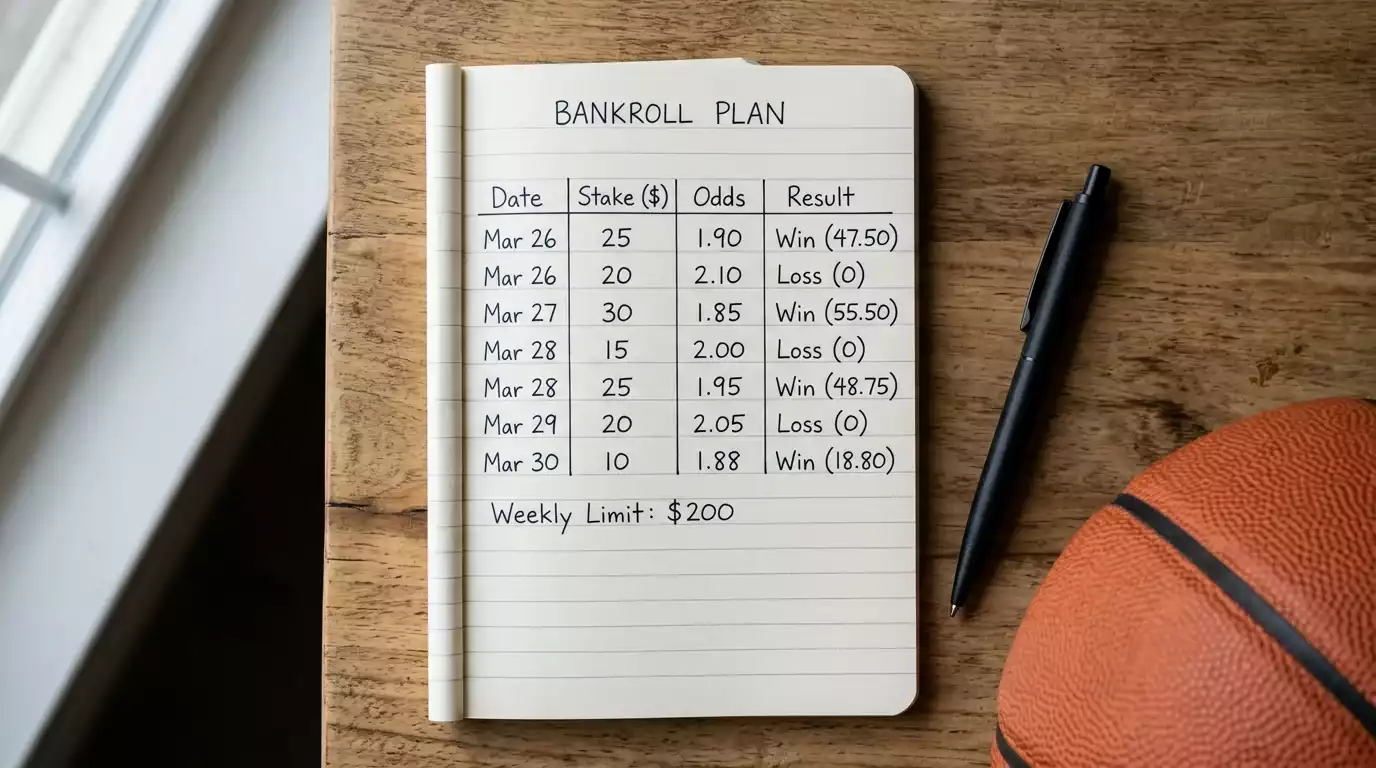
In my third year of serious NBA betting, I hit 57% on point spreads over a two-month stretch. I was convinced I’d cracked the code. Then I ran the numbers and realized I was barely profitable because my bet sizing was erratic — big wagers on games I felt “sure” about, small ones on everything else. My best analytical months were being cannibalized by my worst sizing decisions. That’s when I built a bankroll system, and it was the single most impactful change I’ve ever made.
Professional bettors target a win rate of 53-55%, which yields roughly 3-5% return on investment over an NBA season. Those numbers sound modest until you realize what they demand: not just picking winners consistently, but surviving the inevitable losing streaks that occur even at a 55% hit rate. A bettor hitting 55% will still lose five, six, even eight bets in a row multiple times per season. Without a bankroll plan, those streaks wipe out months of accumulated profit. With one, they’re just statistical noise.
Bankroll management isn’t the exciting part of sports betting. Nobody brags about their unit sizing at a bar. But it’s the structural difference between bettors who are still profitable after three years and those who blew through their savings in three months.
The Unit System: Sizing Bets Relative to Your Bankroll
The concept is simple: define a “unit” as a fixed percentage of your total bankroll, and bet in units rather than dollar amounts. If your bankroll is $5,000 and your unit is 2%, every standard bet is $100. You never bet more than 1 unit on a standard play and no more than 2-3 units on your strongest conviction bets. The percentages matter more than the dollar amounts.
Why percentages instead of flat dollar amounts? Because your bankroll fluctuates. After a winning week, your $5,000 might be $5,400. Your unit becomes $108. After a losing week, your bankroll drops to $4,600. Your unit drops to $92. This natural adjustment — betting more when winning, less when losing — is the core mechanism that protects you from ruin during cold streaks while maximizing growth during hot ones.
I use a 2% standard unit for most NBA bets. On games where my model shows a 5+ point edge against the closing line, I’ll go to 3%. I never exceed 3% on a single game, and I never bet more than 6% of my bankroll on any single night across all games combined. These limits feel conservative when you’re on a heater. They feel brilliant when you’re not.
The Kelly Criterion — a mathematical formula for optimal bet sizing based on your edge and the odds — is the theoretical gold standard. It tells you to bet a fraction of your bankroll equal to your edge divided by the odds. In practice, full Kelly is too aggressive for most bettors because it assumes your edge estimate is perfectly accurate, which it never is. I use quarter-Kelly as my ceiling, which sacrifices some theoretical growth for substantially lower risk of ruin. Over a full 82-game NBA season with 200+ bets, the reduced variance is worth far more than the marginal return of full Kelly.
Realistic ROI Targets Over an NBA Season
If someone tells you they’re making 20% ROI betting NBA games, they’re either lying, on an unsustainable heater, or betting such low volume that the sample size is meaningless. The realistic ROI range for a skilled NBA bettor over a full season is 3-5%. On a $10,000 bankroll betting 1-2 units per game across 200 plays, that’s $300-$500 in profit after five months of daily work.
That number disappoints most people, and honestly, it disappointed me at first too. But context matters. A 4% ROI on 200 bets at $200 per bet means $1,600 in profit. Scale the bankroll to $50,000 and the same percentage yields $8,000. The ROI percentage stays constant; the dollar amount scales with bankroll size. The first year is about proving the process works. The second year is about scaling responsibly.
Monthly variance within that annual ROI is enormous. I’ve had months at +12% and months at -8%. A profitable NBA betting season doesn’t feel profitable in real time — it feels like a grind punctuated by streaks in both directions. The bettors who survive are the ones who don’t panic during the -8% months and don’t get reckless during the +12% months. Both reactions destroy the bankroll plan.
Tilt Control and Losing Streak Protocols
Cait Huble of the National Council on Problem Gambling has described the current expansion of sports betting as the largest and fastest explosion of gambling the country has ever seen. That speed means bettors face more opportunities to lose control in a single evening than previous generations faced in a month. Tilt — the emotional state where losses trigger increasingly reckless betting — is the number one bankroll killer, and it doesn’t discriminate between beginners and experienced bettors.
I have a personal protocol for losing streaks that I follow without exception. If I lose three consecutive bets, I stop betting for the rest of the day and review each loss. Was it a bad beat (the right side of a close game) or a bad bet (a position my model didn’t support strongly)? If I lose five straight across multiple days, I reduce my unit size from 2% to 1% for the next week. This isn’t punishment — it’s risk reduction during a period when my confidence and judgment might be compromised.
The hardest rule to follow: after a losing day, never increase the next day’s action to “make it back.” I call this the recovery trap, and it’s responsible for more blown bankrolls than any other behavioral pattern. If you lose $400 on Tuesday, the instinct is to bet $600 on Wednesday to recover. But you’re now betting 150% of your normal amount on a day when your emotional state is compromised. The compounding risk is catastrophic.
Set a daily loss limit — I use 4% of my bankroll — and enforce it mechanically. When the limit is hit, close the app. Watch the games if you want, but don’t bet. The NBA plays nearly every day for six months. There’s always another opportunity tomorrow. The bankroll you preserve tonight is the bankroll that funds the edge you’ll find next week.
Building a bankroll plan isn’t just about math. It’s about creating a structure that protects you from your worst instincts during the moments when your worst instincts are strongest. The 82-game NBA season is a marathon, and the bettors who treat their bankroll like a marathon resource — pacing, conserving, adjusting — finish ahead of the ones sprinting through every night’s slate like it’s the last game of the season.
