
Loading...
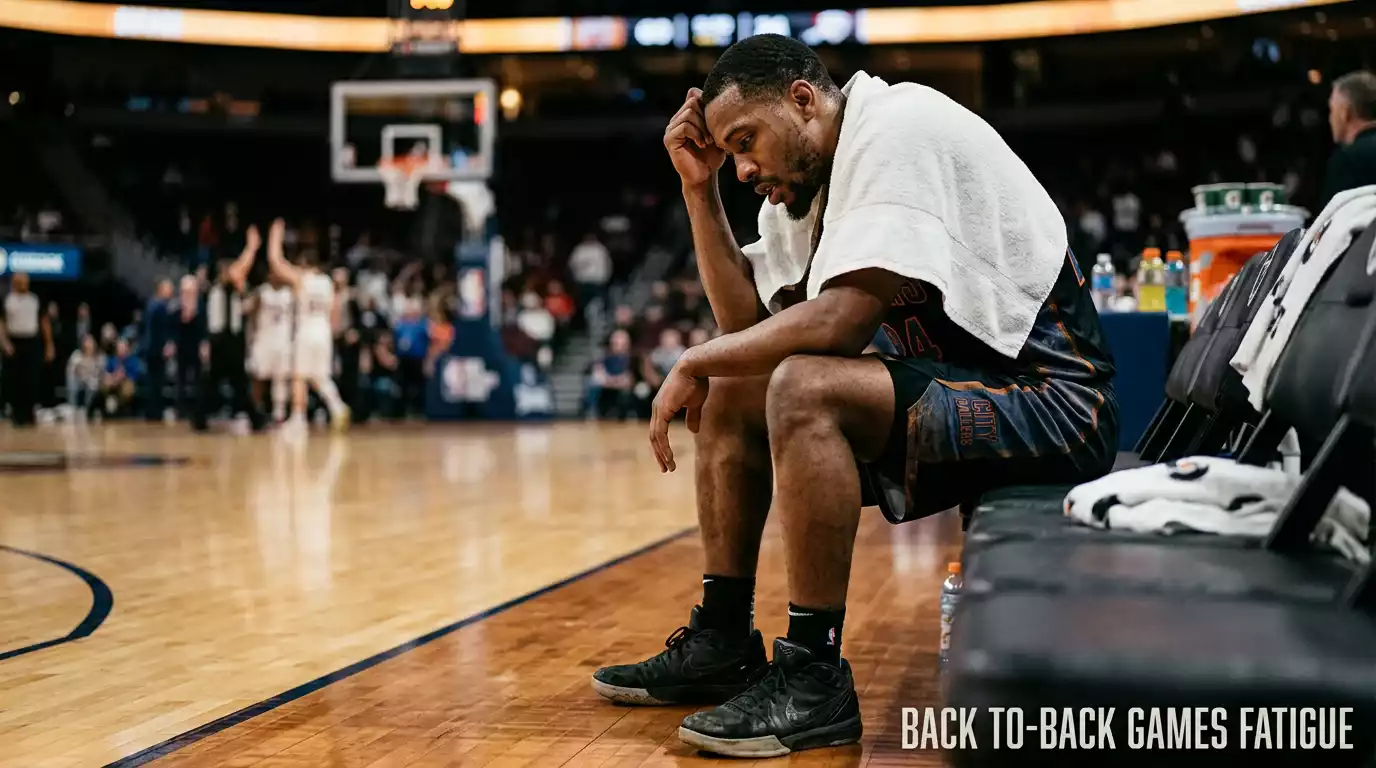
Two seasons ago I built a filter in my model that flagged every game where one team was playing its second game in two nights. I bet the opponent against the spread on 47 games that season. I went 29-18. That’s a 61.7% hit rate on a strategy that required zero film study, no injury analysis, and about five minutes of schedule checking per week. Back-to-back fatigue is the most well-documented and persistent edge in NBA betting — and the sportsbook still doesn’t price it fully.
The number that frames this entire discussion: teams on the second night of a back-to-back lose against the spread in approximately 57% of cases. That figure has held remarkably steady across multiple seasons despite the NBA’s efforts to reduce scheduled back-to-backs. The league has trimmed the average from about 18 per team a decade ago to roughly 12-14 per team now, but the fatigue effect on the remaining games hasn’t diminished. If anything, the reduced frequency makes each back-to-back more impactful because teams are less conditioned for them.
This isn’t a marginal effect. In a market where professional bettors target 53-55% win rates for long-term profitability, a 57% baseline before any additional analysis is a substantial head start. The challenge is identifying which back-to-back situations carry the strongest signal and which have already been priced into the line.
Recovery Science: The 48-Hour Window and Performance Drop-Off
I spoke with a former NBA strength coach at a league event a few years back, and his explanation stuck with me: “The game isn’t the problem. It’s the 14 hours between the final buzzer and the next morning’s shootaround.” Recovery in professional basketball isn’t passive rest — it’s an active process involving cold therapy, soft tissue work, sleep optimization, and nutritional timing. On a normal schedule, teams get 48-72 hours between games. On a back-to-back, that window compresses to roughly 18-22 hours depending on travel.
Research by Garcia et al. measured physical performance across NBA games and found that player output declines from the first quarter to the fourth with an effect size of -1.27 — a statistically large drop. On the second night of a back-to-back, that decline starts earlier. Players enter the game with accumulated fatigue from the previous night, which manifests as lower shooting percentages, fewer contested rebounds, and slower defensive rotations. The fourth quarter of a back-to-back game is where the fatigue bill comes due most visibly.
Not all recovery windows are equal. A team that plays at home on Tuesday and home again on Wednesday has a meaningfully different recovery profile than a team that plays in Miami on Tuesday night and flies to Chicago for a Wednesday game. The travel component compounds the sleep disruption, and sleep is the single most important recovery variable according to every sports science source I’ve consulted. When you see a team playing the second of a road back-to-back after crossing a time zone, you’re looking at a compounded fatigue situation that the market rarely prices aggressively enough.
ATS Records on Back-to-Backs: Conference and Home/Away Splits
The aggregate 57% ATS loss rate on back-to-backs is the starting point, not the whole picture. When I break the data down by conference and venue, the patterns sharpen considerably.
Western Conference teams on back-to-backs perform worse ATS than Eastern Conference teams, and the reason is geography. The West covers more ground — a Portland-to-Phoenix road trip spans 1,500 miles, while an Eastern swing from Philadelphia to New York is under 100 miles. Travel distance and time zone changes amplify the fatigue baseline. My records show Western Conference road back-to-backs losing ATS at roughly 60-62% over the last four seasons, compared to about 54% for Eastern Conference home back-to-backs.
Home court advantage in the NBA runs about 61.55% over 24 seasons of data, and it provides a partial buffer against fatigue. Teams playing the second of a back-to-back at home cover more frequently than teams doing so on the road. The familiar arena, routine, and lack of travel offset some of the physiological toll. But “more frequently” doesn’t mean “frequently enough to bet on.” The home team on a back-to-back still underperforms its typical ATS rate — just not as dramatically as the road team.
The sharpest angle I’ve found is the rest differential: one team on a back-to-back facing an opponent with two or more days of rest. In those situations, the rested team has a compounding advantage — full recovery, fresh legs, game-plan preparation time — against a fatigued opponent running on fumes. These matchups don’t happen every night, but when they do, the ATS percentages skew heavily toward the rested side.
Travel Distance and Time Zones as Compounding Fatigue Factors
Last season I started tracking a variable I call “fatigue load” — a composite of days rest, travel miles in the previous 72 hours, and time zone changes. The results were striking. Teams with a fatigue load in the top quartile (worst fatigue conditions) covered the spread only 39% of the time. The bottom quartile (best rest conditions) covered at 56%. That’s a 17-percentage-point gap driven entirely by scheduling.
Time zone changes are particularly brutal westbound. A team flying from the East Coast to the West Coast loses three hours, which compresses the recovery window even further. The body’s circadian rhythm doesn’t adjust instantly, and a 7:00 PM tip-off in Los Angeles feels like 10:00 PM to a team from Boston. Late-game execution — the minutes that most often decide covers — suffers measurably. Eastbound travel is slightly less disruptive because losing time zones means earlier tip-offs relative to the body clock, but the effect is still negative.
Altitude deserves a specific mention. Games in Denver on a back-to-back are the single most predictable fatigue-plus-environment combination in the NBA schedule. Visiting teams already face reduced oxygen at Ball Arena’s 5,280-foot elevation. Add travel fatigue and zero days’ rest, and the performance drop-off extends beyond what the spread typically accounts for. I flag every Denver back-to-back game on the calendar at the start of each season and evaluate them as potential plays before any other analysis.
The point spread market accounts for back-to-back scheduling — the line is adjusted when a team plays on zero days’ rest. But my data consistently shows the adjustment falls short by about 1-1.5 points in the most extreme fatigue situations. That gap is small on any individual game but compounds over a full season of selective betting. The edge isn’t glamorous. It’s schedule reading and data tracking. But six years of results tell me it works.