
 Available in US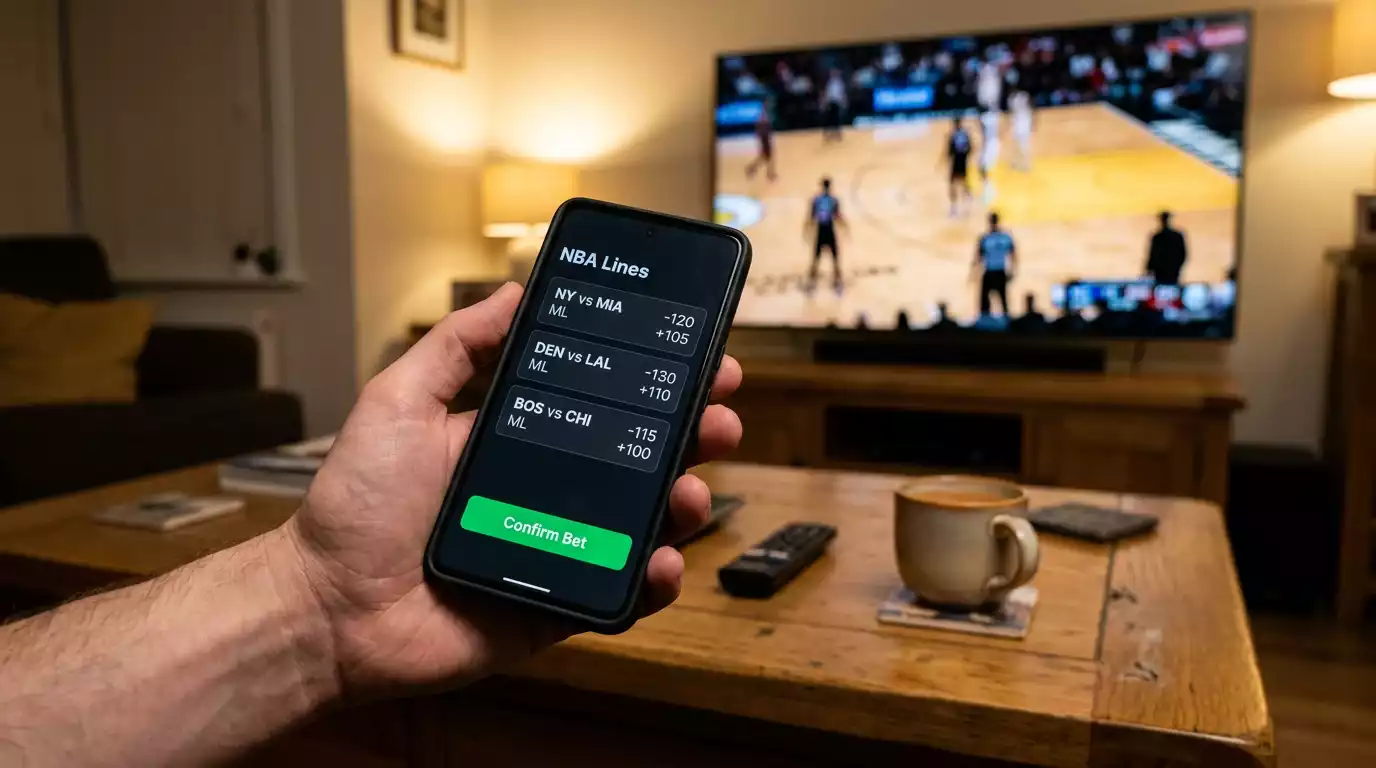
I placed my first NBA bet at a physical sportsbook counter in 2019. I filled out a paper slip, handed it to a clerk, and waited for a printed ticket. That feels like a different era. Now 90% of sports bets are placed through mobile apps, and the shift isn’t just about convenience — it fundamentally changed how, when, and how often people bet on NBA games. The phone in your pocket is a 24/7 sportsbook, and the quality of that sportsbook’s mobile experience directly affects your betting results.
Charlie Baker, the NCAA president, captured the transformation candidly when he noted that nobody was thinking in 2018 about how fast the entire industry would end up in the palm of your hand. The speed of mobile adoption reshaped the market: live betting exploded because you can bet from your couch while watching the game, prop markets expanded because the app interface makes complex bets accessible, and betting frequency increased because the friction between impulse and action dropped to zero. That frictionless environment is both the opportunity and the risk.
Core Features That Separate Good NBA Betting Apps From Bad Ones
Not all sportsbook apps are created equal, and the differences matter more for NBA bettors than for casual once-a-week football bettors. NBA betting involves multiple games per night, rapid line movements, live betting during action, and deep prop menus that require fast navigation. A clunky app doesn’t just frustrate you — it costs you money by slowing your execution when speed matters.
The bet slip experience is the core interaction. How many taps does it take to find a game, select a market, enter a stake, and confirm the bet? The best apps get this done in four taps. The worst require six or seven, with unnecessary confirmation screens or slow-loading market menus in between. I timed the process across four major sportsbook apps: the fastest averaged 8 seconds from market selection to confirmed bet, the slowest averaged 19 seconds. On a live bet where the line is moving, those 11 extra seconds can mean a rejected bet or an unfavorable repricing.
Market organization determines how quickly you can find the bet you want. An app that buries player props three menu levels deep makes it impractical to browse prop markets during a live game. The strongest apps present all available markets for a game on a single scrollable screen with clear category tabs: spread, moneyline, total, player props, game props, quarter lines. Weak apps separate these into different pages that require loading time and back-button navigation.
Push notifications for line movements, injury reports, and bet settlements keep you informed without requiring you to stare at the app. I configure my sportsbook apps to notify me when a line moves more than a point on any game in my watchlist and when an injury report is posted for a team I’m tracking. These notifications are the difference between catching a repricing window and missing it entirely.
Live Betting Latency: Why Milliseconds Matter for NBA In-Play
More than half of all sports bets are now live bets placed during the game, and for NBA specifically, the live betting share is even higher. The pace of basketball — a scoring event every 20-30 seconds, constant momentum shifts, fouls and free throws that change dynamics rapidly — makes live betting the natural habitat for engaged NBA bettors. But the live betting experience is only as good as the platform’s latency.
Latency in live betting is the delay between you tapping “place bet” and the sportsbook either accepting or rejecting your wager. During that delay, the line is moving in real time. If a basket is scored between your tap and the book’s response, your bet might be rejected, repriced, or accepted at different odds than you intended. The shorter the latency, the more control you have over the price you get.
In my testing, latency across major sportsbook apps ranged from 1.5 to 6 seconds during active NBA game play. The fastest apps accept live bets within 2 seconds in most conditions. The slowest take 4-6 seconds, and during high-traffic moments (fourth quarter of a close game, immediately after a momentum swing), latency spikes further. A 5-second delay during the fourth quarter of a close game might mean your bet is rejected three times before it’s finally accepted at a worse price.
The apps with the best live betting infrastructure tend to be the ones with the largest engineering budgets — the major operators who’ve invested heavily in server architecture and real-time odds calculation. Smaller sportsbooks that license their technology from third-party providers typically have higher latency because the odds calculation happens on someone else’s servers. If live NBA betting is central to your strategy, prioritize platforms that demonstrate fast, reliable live execution over those that offer marginally better pre-game odds.
Geolocation and State Verification: What Happens When You Cross a Border
Sports betting is legal in 38 states plus DC, but that legality is geographically locked. Every sportsbook app uses geolocation technology to verify that you’re physically located within a state where they’re licensed to operate. This verification happens when you open the app and again when you place each bet. If the geolocation check fails — because you’ve crossed a state line, because your phone’s GPS is inaccurate, or because the verification service is experiencing technical issues — your bet is blocked.
For NBA bettors who live near state borders, geolocation creates practical complications. I know bettors in the New York/New Jersey/Connecticut corridor who have three different sets of sportsbook accounts because the licensed operators differ by state. Crossing the George Washington Bridge means your New Jersey accounts deactivate and your New York accounts activate. If you’re in the middle of building a live bet when you cross the border, the bet gets rejected.
Airport and stadium geolocation introduces another wrinkle. Airports near state borders can trigger false-state geolocation, blocking access to your accounts even though you’re technically still in a legal state. Arenas that sit close to state lines (there are a few in the NBA) can cause similar issues. The technology is accurate enough for most situations but imperfect at the margins.
VPN usage to circumvent geolocation is a violation of every sportsbook’s terms of service and can result in account closure, forfeiture of funds, and in some jurisdictions, legal consequences. The geolocation system exists for regulatory compliance, and attempting to bypass it puts your accounts and your bankroll at risk. If you travel frequently between states, maintaining accounts at sportsbooks licensed in each state you visit is the legitimate workaround — tedious but necessary for anyone who takes NBA betting seriously enough to bet on the road.
