
 Available in US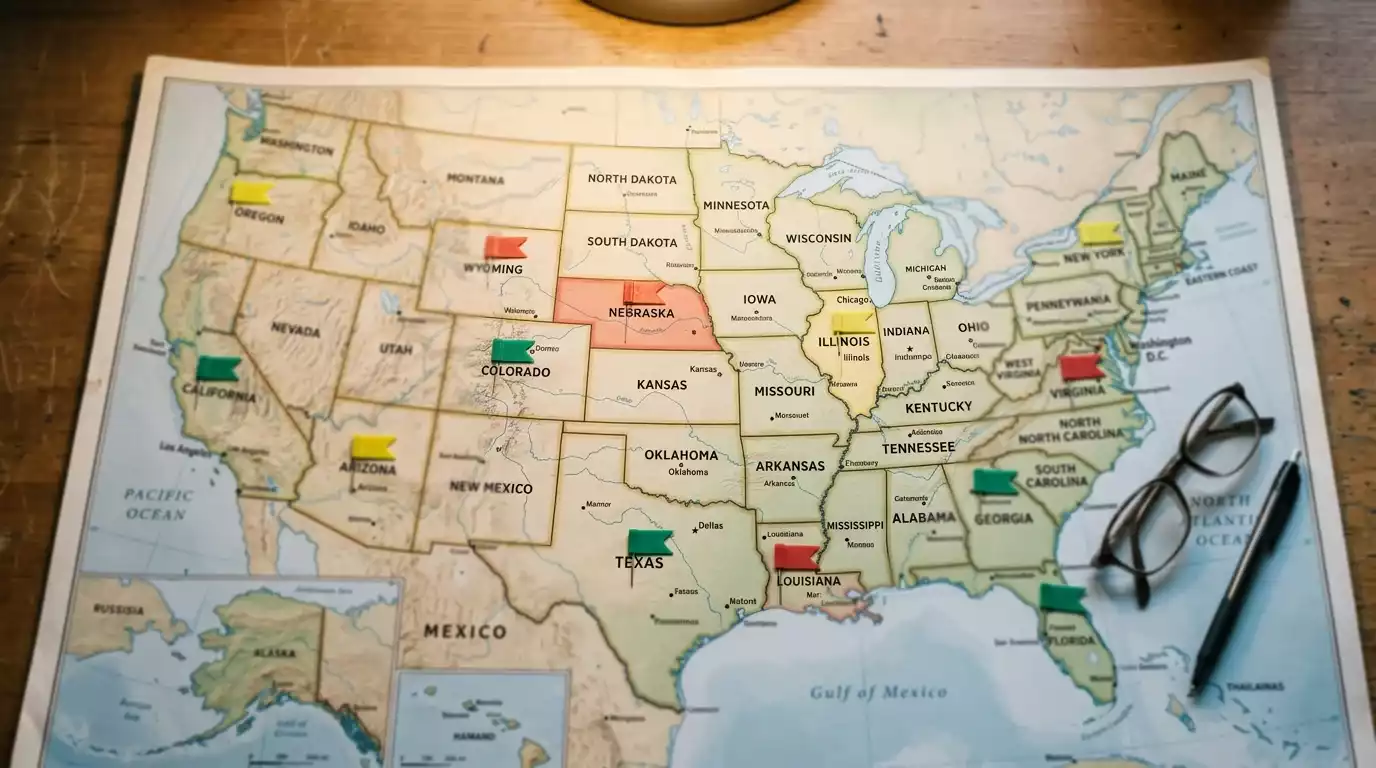
I placed my first legal NBA bet in 2019, about a year after the Supreme Court struck down PASPA and opened the door for states to legalize on their own terms. At the time, a handful of states had launched markets. Now 38 states plus DC have legalized sports betting, and the patchwork of regulations across those jurisdictions would make a tax attorney’s head spin. What you can bet on, how you can bet, and how much you’ll owe the government all depend on which side of a state line you’re standing on.
Sports betting is legal in 38 states and the District of Columbia, with online access available in more than 30 of those jurisdictions. That sounds like broad access, and it is compared to the pre-2018 landscape when Nevada stood alone. But “legal” doesn’t mean uniform. Some states allow mobile betting from anywhere within their borders. Others restrict it to within the physical confines of a casino. Some have no restrictions on prop bets. Others have banned certain prop categories following integrity concerns. The regulatory landscape is a maze, and navigating it is part of being an informed bettor.
Online vs. Retail: The State-by-State Access Map
The fundamental divide in US sports betting regulation is between online and retail-only states. Online states — where you can open an app from your couch and place an NBA bet — account for the vast majority of betting volume. The convenience of mobile betting has driven the industry’s explosive growth; more than 90% of all sports bets in the US are placed through mobile platforms.
Retail-only states restrict betting to physical sportsbook locations, typically inside casinos or racetracks. These markets generate a fraction of the revenue that online states produce because the friction of traveling to a casino eliminates casual betting. A bettor in an online state might place three NBA bets on a random Tuesday while watching from home. A bettor in a retail-only state would need to drive to a casino to do the same thing, which most people simply won’t do on a weeknight.
Several states occupy a middle ground, allowing online registration but requiring an in-person identity verification step at a licensed location before your account goes live. Others restrict the number of mobile operators — some states have as few as two licensed platforms, while competitive markets like New York, New Jersey, and Illinois have a dozen or more. The number of operators directly affects odds quality: more competition means tighter lines and better prices for bettors. States with limited competition tend to have wider vig because the licensed operators face less pricing pressure.
The remaining states that haven’t legalized — including California, Texas, and Florida (where the legal status has been challenged in court) — represent the largest untapped markets. If and when those states launch, the national betting handle would increase dramatically, potentially adding tens of billions in annual volume. For now, bettors in those states have no legal avenue for NBA wagering, and offshore platforms operate outside the regulatory protections that licensed sportsbooks provide.
Tax Structures: From Illinois’s 40% to Nevada’s Flat Rate
The tax regime your sportsbook operates under affects you even if you never look at a tax form. Operators pass their tax burden to bettors through the vig — higher state taxes on sportsbook revenue mean wider juice on the lines you’re betting. Regulated sports betting generated $3.71 billion in state taxes during 2025, a 32.4% increase over the prior year, and states are still experimenting with how aggressively they can tax the industry without killing the golden goose.
Illinois became the cautionary tale in 2025. The state implemented a progressive tax rate reaching up to 40% on operator revenue plus a fixed fee of $0.25-$0.50 per bet. The result was measurable: a 15% decline in betting volume during the fall as operators raised prices to maintain margins and some bettors migrated to neighboring states with friendlier tax structures. Nevada, by contrast, maintains one of the lowest effective tax rates in the country, which helps explain why Vegas sportsbooks still offer some of the sharpest odds available.
Representative Paul Tonko, author of the SAFE Bet Act, has argued that the exclusively state-based regulatory approach is fundamentally flawed, jeopardizing both sports integrity and public health. Whether or not you agree with his politics, the data supports the structural critique: wildly different tax rates create regulatory arbitrage where operators (and bettors) gravitate toward lower-tax jurisdictions, undermining the revenue goals of high-tax states.
As a bettor, the practical implication is straightforward: the state you bet from affects the odds you get. If you live near a state border, checking whether the neighboring state’s sportsbooks offer better lines is worth the effort. Some bettors in high-tax states report consistently finding 5-10 cents better odds at sportsbooks in neighboring lower-tax jurisdictions, which adds up over hundreds of bets per season.
The SAFE Bet Act and the Push for Federal Standards
The SAFE Bet Act, introduced in Congress in both 2024 and 2025, represents the most serious push for federal oversight of sports betting since legalization began. The bill proposes establishing federal minimum standards for consumer protection, advertising restrictions, and integrity monitoring — effectively creating a regulatory floor that all states would need to meet.
NBA Commissioner Adam Silver has publicly supported more regulation and expressed a preference for federal legislation over the current state-by-state approach, noting the need to monitor the volume of promotion and advertising around betting. The league’s position reflects a pragmatic calculation: unified regulation is easier to cooperate with than navigating 38 different state frameworks, and stronger consumer protections reduce the reputational risk to the NBA brand.
The American Gaming Association has pushed back, with its leadership arguing that sports betting belongs under state and tribal regulation, where consumers are protected and communities share in the benefits. The AGA’s position is that state regulators understand their markets better than federal agencies would and that the current system, despite its inconsistencies, has produced record revenue and strong consumer uptake.
For bettors, the SAFE Bet Act’s practical impact — if it passes — would depend on the specific provisions. Federal advertising restrictions could reduce the constant bombardment of sportsbook promotions. Standardized consumer protection rules could mean uniform self-exclusion programs, deposit limits, and responsible gambling tools across all states. But federal oversight could also mean standardized tax structures (likely higher than the lowest-taxed states currently offer) and additional compliance costs that operators pass through as wider vig.
Whether or not the SAFE Bet Act becomes law, the trend is clear: the regulatory environment around NBA sports betting is tightening. More oversight, more transparency, and more standardization are coming. Bettors who understand the regulatory landscape — not just the odds on the board — position themselves to adapt as the rules continue to evolve.
