
 Available in US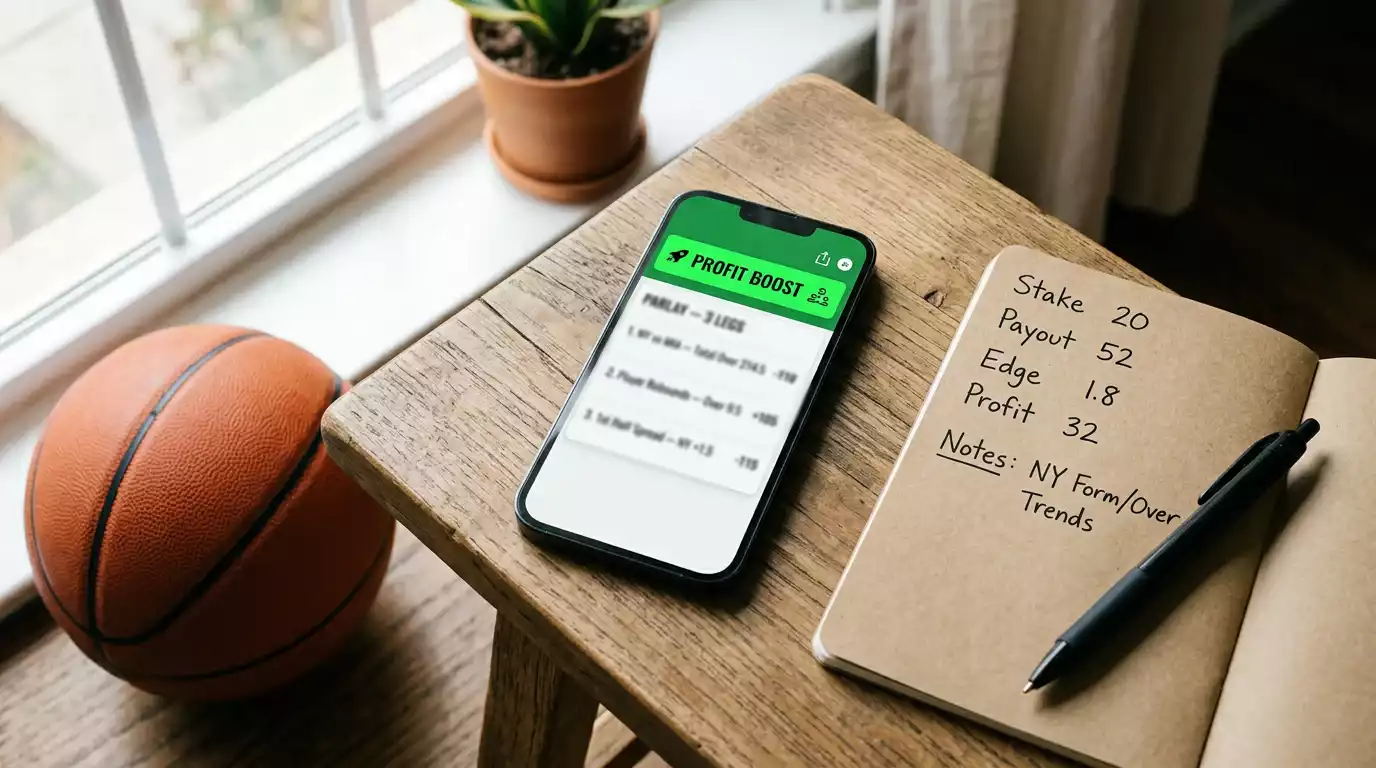
Every Thursday night during the NBA season, my phone buzzes with a notification from three different sportsbooks: “NBA Profit Boost! Get 50% more on any 3+ leg parlay tonight!” The first time I saw one of these, I thought I’d found free money. Now, after calculating the actual expected value on about 200 boosted parlays, I know exactly what they are: customer acquisition tools dressed up as generosity. Some boosts genuinely offer positive expected value. Most don’t. Knowing the difference is a skill worth developing.
Parlay bets doubled in popularity from 2018 to 2024 — 30% of sports bettors built parlays in 2024 compared to 17% six years earlier. Sportsbooks promote parlays this aggressively because parlays generate roughly 60% of their revenue from about 30% of their handle. The parlay market is where the operator margin is widest, and boosts are the lure that brings casual bettors to that high-margin product. Understanding this incentive structure is the first step toward using boosts strategically rather than being used by them.
Calculating True Value: Is the Boost Beating the No-Vig Line?
The only way to evaluate a boosted parlay is to compare the boosted odds to the no-vig (true probability) odds of the underlying legs. If the boosted payout exceeds what you’d expect from a fair market with zero sportsbook margin, the boost has positive expected value. If it doesn’t, the boost is just a smaller loss than you’d take at the unboosted price — still negative expected value, just less negative.
Here’s the process I use on every boost. Take a boosted three-leg parlay offering +500 on three NBA moneyline favorites. First, convert each leg to its no-vig implied probability. If the three favorites have true win probabilities of 70%, 65%, and 72%, the combined probability is 0.70 x 0.65 x 0.72 = 32.76%. The no-vig fair odds for that parlay are approximately +205. The boosted +500 implies a 16.7% probability, far less than the true 32.76% — this boost is massively positive expected value.
That example is unusually generous. More typically, the boost is modest. A “25% profit boost” on a three-leg parlay might take a standard +350 parlay to +437. If the no-vig fair odds are +400, the boosted +437 is slightly positive expected value — but only by about 2-3%. That’s an edge, but a thin one that doesn’t survive if any of your leg probabilities are slightly overestimated.
The calculation takes about five minutes per boost, and most boosts don’t pass the test. Out of approximately 200 boosts I’ve evaluated over two seasons, about 30-35% offered genuine positive expected value. The rest were either neutral or still negative EV despite the boost. The ones that are genuinely profitable tend to be the less-promoted boosts — Tuesday afternoon specials rather than marquee Thursday night promotions — because the sportsbook prices the high-visibility boosts more carefully.
Types of NBA Promotions: Boosts, Bonus Bets, and Insurance
Sportsbook promotions fall into three main categories, each with different expected value profiles and different strategic implications for NBA bettors.
Odds boosts increase the payout on a specific bet or parlay. The value depends entirely on whether the boosted price exceeds the no-vig fair value, as described above. Boosts are the most common promotion and the easiest to evaluate because the math is transparent — you can calculate whether the boost has positive EV before you place the bet.
Bonus bets (sometimes called “free bets”) give you a credit that you can wager without risking your own money. The catch: if the bonus bet wins, you collect the profit but not the original stake. A $100 bonus bet at +100 pays $100 in profit if it wins, not the $200 total return you’d get from a $100 cash bet. The expected value of a bonus bet is approximately 40-50% of its face value, depending on the odds you use it on. Optimal strategy: use bonus bets on longshots (+300 or higher), where the profit-only structure costs you less relative to the potential payout.
Bet insurance refunds your stake (usually as a bonus bet, not cash) if your wager loses. A “$250 first bet insurance” means if your first bet loses, you get a $250 bonus bet as consolation. The expected value is the probability of losing multiplied by the expected value of the resulting bonus bet. If you place your first bet at -110 (approximately 52.4% chance of winning), you lose about 47.6% of the time, triggering a bonus bet worth roughly 45% of $250 ($112.50). The promotion’s net expected value is about 47.6% x $112.50 = $53.55 — decent but far less than the headline $250 suggests.
Reading the Terms: Wagering Requirements and Expiration Pitfalls
Parlays generate the sportsbook’s widest margins, and the terms attached to promotions are designed to keep you engaged with those high-margin products. The two most common pitfalls are wagering requirements and expiration timelines.
Wagering requirements specify how much you must bet before promotional funds become withdrawable. A $200 deposit match with a 5x wagering requirement means you need to wager $1,000 before you can cash out any bonus-derived winnings. At a standard 5% hold rate, you’ll lose approximately $50 in expected juice meeting that requirement — reducing the effective value of the $200 bonus to about $150. At 10x requirements, the expected loss in juice approaches or exceeds the bonus value entirely, making the promotion essentially worthless.
Expiration timelines force you to act within a window — typically 7-14 days for bonus bets and 30-60 days for deposit match wagering requirements. The pressure to use a bonus before it expires leads bettors to place bets they wouldn’t otherwise make, which is exactly the behavioral outcome the sportsbook is designing for. I’ve watched bettors turn a positive-EV bonus into a net loss by forcing bets on games they hadn’t analyzed just to meet a deadline.
My framework for promotions: calculate the expected value after accounting for terms, wagering requirements, and the opportunity cost of forced bets. If the net EV is positive and I can meet the terms with bets I’d make anyway, I take the promotion. If the terms require me to bet outside my normal process — more volume, different markets, tighter timeline — I pass. The sportsbook’s goal is to change your behavior. Your goal is to extract value without changing your process.
