
 Available in US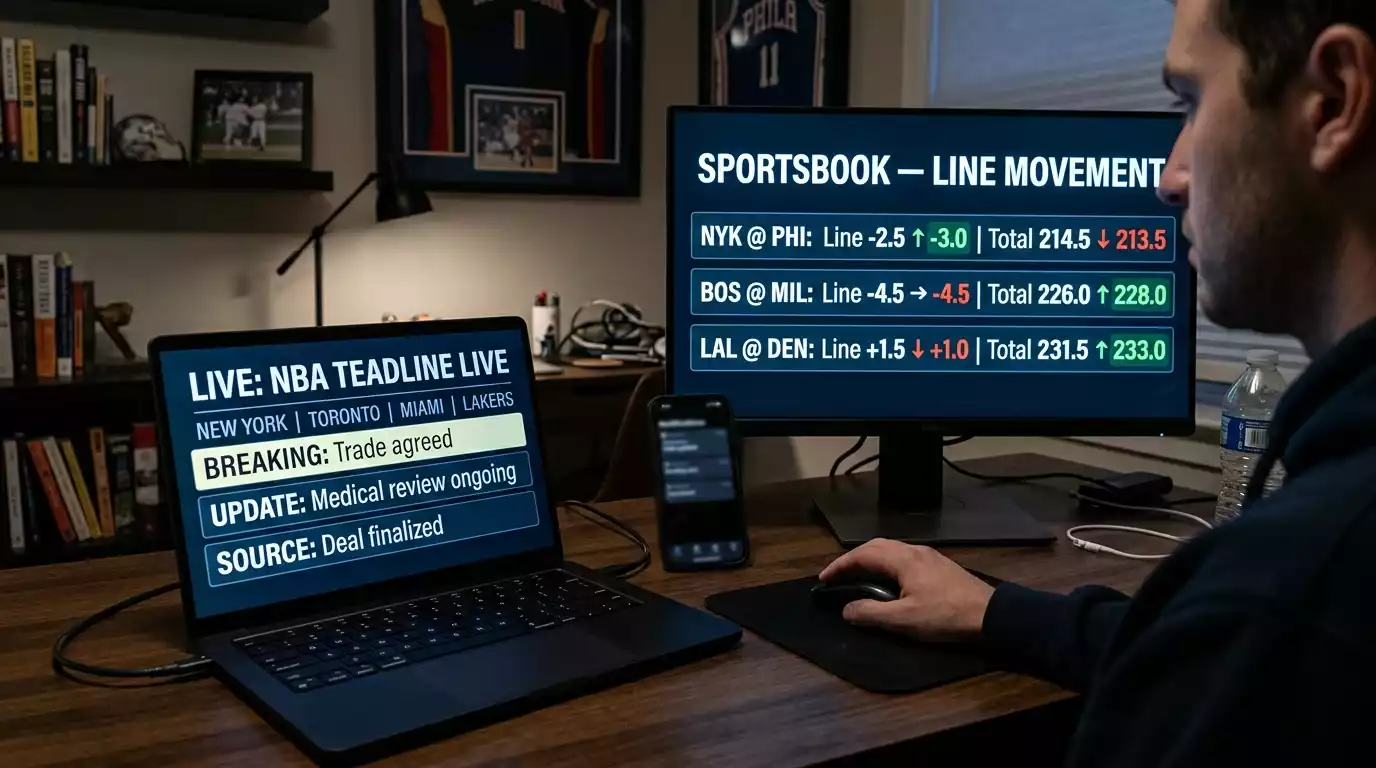
On deadline day last February, I had my model open on one screen and a live trade tracker on the other. When a blockbuster deal was announced at 2:47 PM Eastern, I watched the acquiring team’s championship futures tighten by 30% within ten minutes — but their next game’s spread didn’t move for nearly an hour. That hour was the widest repricing gap I’d seen all season, and it exists because sportsbooks reprice futures and game lines on different timescales. The deadline is the one day where that gap is most exploitable.
The NBA trade deadline — typically in early to mid-February — is a structural disruption to the betting market. Rosters change, rotations are reshuffled, and the data your model was trained on becomes partially obsolete overnight. Sportsbooks face the same challenge: their power ratings need to be recalculated for teams that added or subtracted significant talent, and that recalculation doesn’t happen instantly. The absence of a key player can swing an NBA spread by 4-8 points in normal circumstances, and a midseason acquisition has a comparable but inverse effect that takes longer for the market to fully digest.
How Mid-Season Trades Move Spreads, Totals, and Futures
Trades affect different betting markets at different speeds, and understanding that sequence is how you find value on deadline day and the week that follows.
Futures react fastest. Championship odds, win totals, and award markets adjust within minutes of a major trade because futures desks at sportsbooks monitor trade news in real time and have pre-calculated scenarios for likely deals. A team that acquires a star player sees its championship odds shorten immediately, often before the official trade confirmation is posted. If you’ve been monitoring trade rumors and have a view on which deals are imminent, positioning your futures bets before the announcement captures the maximum price movement.
Game spreads react slower, especially for games that aren’t scheduled within 24 hours of the trade. The next day’s spread might adjust within an hour of a trade announcement, but a game three days out might not reflect the roster change until the line opens. The sportsbook needs time to assess how the new player fits into the rotation, whether he’ll play in his first game with the team (some players need days to clear physicals and learn the playbook), and how the minutes redistribution affects the team’s projected efficiency.
Totals are the slowest to fully adjust because the pace and defensive implications of a roster change take longer to model. A team that trades for a high-pace guard will likely play faster, pushing totals up — but by how much? The answer depends on how quickly the coach integrates the new player, which lineups he uses, and how the opposing team adjusts. Sportsbooks typically wait for 2-3 games of post-trade data before they significantly adjust their totals projections for the traded-to team.
Player Prop Markets After a Trade: New Team, New Numbers
Player props are where the trade deadline creates the most sustained betting opportunities, because the repricing challenges for individual player lines persist for weeks — not just hours or days.
When a player changes teams, his usage rate, pace context, and role often change dramatically. A wing who was the third option on a loaded roster becomes the first option on a thinner team. His scoring prop should increase, but the sportsbook’s opening prop line for his first game with the new team is often anchored to his previous team’s numbers. That anchoring bias creates a predictable gap between the prop line and the true expected production in the new context.
Block props show win rates of 69.9% on overs this season, and trade-related roster changes amplify the opportunity. A team that trades its starting center creates a cascade where the backup center’s blocks, rebounds, and minutes all increase. The sportsbook adjusts the departed player’s props immediately (removing them from the board), but the replacement’s props lag behind. I’ve tracked this pattern across 30+ midseason trades over four seasons, and the secondary player’s props are consistently mispriced for the first 3-5 games after a trade — the book just doesn’t adjust fast enough to the new rotation reality.
The cascade effect extends to the other team too. The squad that acquired a new player sees its existing players’ roles shift. The point guard who averaged 8 assists might see that number drop as the new acquisition takes over primary ball-handling duties. The stretch four who was the second scoring option might see fewer touches. These downward adjustments are just as valuable as the upward ones, but they’re harder to bet because the props might move toward you less aggressively — “overs” on declining players don’t always offer enough margin.
Timing Your Bets Around Deadline Day
Deadline day has a specific rhythm, and aligning your betting activity to that rhythm maximizes the windows you can capture.
The morning of the deadline is quiet. Rumors are circulating, but confirmed deals are rare before noon Eastern. This is the time to review your model’s scenarios: which teams are rumored to be making moves, what would each move do to the spread and total for upcoming games, and where would the futures settle post-trade? Having those numbers prepared before the deals drop lets you act decisively when the repricing window opens.
The 1-3 PM Eastern window is the most active. Major deals typically close in the final hours before the deadline, and trade confirmation tweets from league reporters create a burst of repricing activity. Futures desks move fast. Game line desks move slower. This is when the gap between futures repricing and game line repricing is widest — the exact window I described in the opening paragraph. If your pre-calculated scenarios match the confirmed deal, this is the time to bet game lines that haven’t yet reflected the roster change.
The 48 hours after the deadline are equally important but less hectic. By this point, all trades are confirmed, and the market begins digesting the implications for team quality, rotation depth, and player usage. The sportsbook’s initial adjustments might overshoot or undershoot — they’re estimating impact in real time with limited data. The first 2-3 games after a trade provide the data that corrects those estimates, and there’s value on both sides of the correction: on the team that was overvalued by the initial adjustment and on the one that was undervalued.
The trade deadline is the most information-dense day of the NBA betting calendar outside of opening night. The bettors who profit from it aren’t the ones reacting fastest — they’re the ones who prepared scenarios in advance, pre-calculated the expected impact of rumored deals, and positioned themselves to act when the confirmation hit. Speed without preparation is just scrambling. Preparation without speed is just watching someone else capture the value.
