
Loading...
The shortest bet I’ve ever placed lasted eleven seconds. Tip-off, possession to the home team, ball swings to the power forward, layup. Over. My first basket bet cashed before most people in the arena had settled into their seats. The thrill was real, but the preparation behind that eleven-second outcome took about forty minutes of research.
First basket bets are the purest prop market in the NBA — a wager on which individual player will score the first points of the game. They live in the overlap between live betting and player props, and more than 90% of all sports bets are now placed through mobile apps, which means this market is available to anyone with a phone and a sportsbook account. The odds typically range from +300 to +1500 depending on the player, reflecting the inherent unpredictability of who touches the ball first and converts.
What makes this market interesting from an analytical perspective is that it’s driven by a small, identifiable set of variables: who wins the tip-off, what play the winning team runs out of the opening possession, and which player is the primary scoring option in that opening set. Unlike full-game bets that depend on 48 minutes of basketball, first basket bets depend on the first 15-30 seconds. That compression makes the research manageable and the patterns surprisingly readable.
Jump-Ball Winners and Opening Possession Patterns
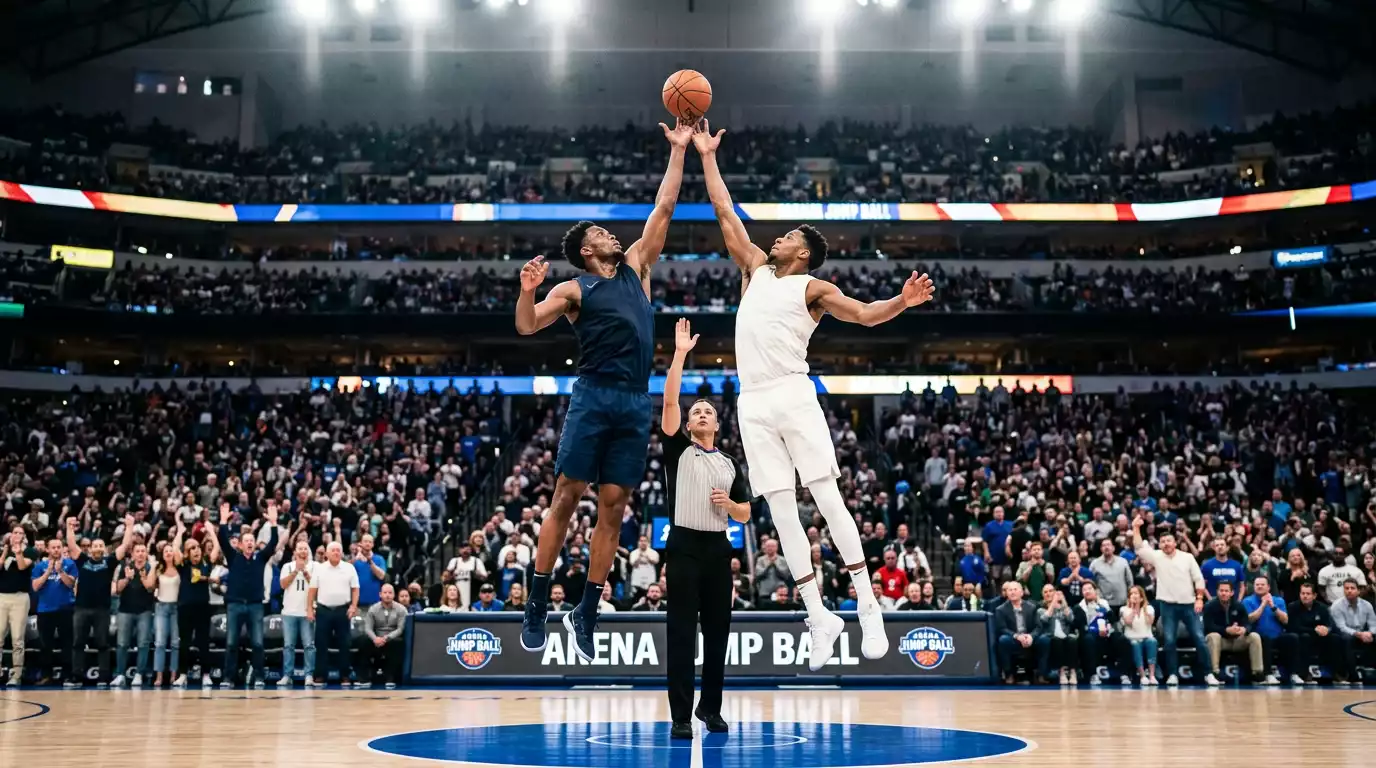
Everything starts at center court. The team that wins the opening tip-off gets the first possession, and the first possession produces the first basket the majority of the time. Not always — turnovers happen, shots miss, the defending team gets a steal and scores in transition. But the jump-ball winner scores first in roughly 55-60% of games based on the data I’ve tracked over four seasons.
Predicting the jump-ball winner is more straightforward than you’d think. It comes down to the starting centers. Some players are elite at tip-offs — guys with long wingspans, good timing, and experience. I keep a running database of tip-off win rates for every starting center in the league. The top performers win their tips at 65-70%, and that number is remarkably consistent game to game. When two elite tip-off centers match up, the edge compresses. When an elite tipper faces a below-average one, the opening possession is nearly predetermined.
The wrinkle is that teams occasionally start a power forward at center or switch their lineup for matchup purposes. A last-minute lineup change can flip the tip-off probability entirely. This is why monitoring starting lineups in the 30 minutes before tip-off is essential for first basket bettors. The injury report and the lineup confirmation are the two pieces of information that most affect this market.
Identifying First-Option Scorers From Opening Sets
Winning the tip-off only matters if you can predict what the team does with that first possession. This is where coaching tendencies become your best friend. Every NBA team has a preferred opening set — a play they run on their first possession of the game with high frequency. Some teams isolate their star player. Others run a pick-and-roll designed to get the ball to the rolling big man. A few teams push pace immediately and look for a transition bucket.
I categorize opening sets into three types: star isolation (the primary scorer gets the ball in space), pick-and-roll action (the ball handler or the rolling center scores), and motion offense (the ball moves through multiple players before a shot). Star isolation sets are the most predictable for first basket purposes because the same player shoots on a high percentage of first possessions. Teams built around a dominant wing or guard who demands the ball early give you a clear target.
Film study matters here. I watch the first two minutes of four or five games for each team early in the season to identify their opening tendencies. Once I’ve cataloged the play type and the primary target, I check whether those tendencies hold over a 10-15 game sample. Most teams are remarkably consistent. A coach who runs a pick-and-roll for his center on the first possession in October is running the same play in March.
The players who show up most frequently as first scorers aren’t always the team’s leading scorer for the game. The first basket market rewards players who are involved in opening sets specifically — often the center finishing a lob or layup, or the point guard pulling up after a pick. Stars who receive the ball in isolation score first at a high rate too, but their odds are typically shorter (+300 to +500) because the market recognizes their involvement. The value often sits with the secondary option who scores first at +700 to +1000 because the opening set is designed to create a mismatch that the sportsbook’s pricing model underweights.
Finding Value: Mismatch Tip-Offs and Coach Tendencies
The best first basket plays combine two edges: a tip-off advantage and a predictable opening set targeting a specific player. When one team’s center dominates tip-offs at 68% and that team runs a high pick-and-roll for their center on the opening possession in 70% of games, the probability chain becomes straightforward. Roughly 68% chance of winning the tip, multiplied by roughly 40% chance that the center scores on the first possession (accounting for misses, turnovers, and defensive stops), gives you about a 27% probability. If the sportsbook is offering +500 (implied probability 16.7%), you have a significant edge.
Mismatch tip-offs are the easiest to spot and the most profitable. When a 7-foot center with a 70% tip-off rate faces a 6-9 power forward starting at center due to a lineup change, the probability of winning the tip skyrockets. These situations arise 3-5 times per week across the league, usually flagged by late lineup changes or rest decisions. I’ve built an alert system that cross-references tip-off data with confirmed lineups, and the notification fires about an hour before tip-off when a mismatch appears.
Coach tendencies also create exploitable patterns during specific schedule spots. After a loss, some coaches go to their star player on the first possession more aggressively — a “statement” start. After a blowout win, others experiment with different opening sets. These behavioral patterns don’t show up in standard statistics but are visible through film review and game-log tracking.
First basket betting isn’t going to be anyone’s primary market. The sample sizes are small, the outcomes are inherently volatile, and the bet amounts are typically capped lower than standard markets. But as a supplementary play within a broader player prop strategy, it offers a unique edge: the preparation is bounded, the variables are identifiable, and the market is thinner than any other NBA betting line. For bettors who enjoy the intersection of data work and game theory, the first basket market rewards that effort faster than any other prop — in about eleven seconds, if you’re lucky.